ROAS has been the default metric for years, but it only looks at revenue. This means campaigns can push products that sell well but bring little (or no) profit. POAS solves this by factoring in profit margins, cost of goods sold (COGS), shipping, and returns.
In today’s campaigns, where automation decides targeting and bidding, POAS provides better signals. Instead of rewarding high-ticket, low-margin items, you teach the algorithm to focus on high-margin, high-profit conversions — leading to healthier, long-term business growth.
Who is it good for:
POAS campaigns suit advertisers who already track costs and profit per product. They’re perfect for brands focused on sustainable, profit-based growth rather than just revenue.
Benefits
Puts profit at the center of your campaign optimization
Creates stronger connection between marketing and finance
More accurate business decisions beyond ROAS
Downsides
Needs accurate cost and margin data (including returns & shipping)
Data can lag, making real-time optimization harder
More complex setup than traditional ROAS campaigns
Risk of under-serving low-margin but strategically important products (e.g., entry-level items)
POAS formula
At its core, POAS tells you how much profit you’re earning for every dollar spent on advertising: POAS = Profit / Ad Spend POAS % = (Profit / Ad Spend) * 100
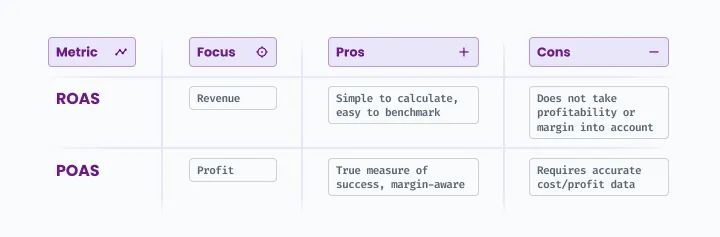
This contrasts with ROAS, which measures revenue per dollar spent: ROAS = Revenue / Ad Spend
Unlike ROAS, which only looks at revenue, POAS includes your product costs, shipping, and returns. This means it doesn’t just measure sales volume, it shows if your ads are actually profitable.
ROAS vs. POAS in practice
No wonder POAS is gaining popularity
ROAS can make results look good without proving profitability. Imagine:
Spend €10 → make €100 revenue → ROAS = 10. But if costs are €90, profit is only €10 → POAS = 1.
Spend €10 → make €50 revenue → ROAS = 5. If costs are €20, profit is €30 → POAS = 3.
Comparison of two similar products and their ROAS + POAS. See the difference?
In the first case, ROAS looks stronger, but POAS shows the second product is three times more profitable. This is why POAS could be a better metric for your business: it helps the algorithm push the products that actually grow profit, not just revenue.
How structuring POAS campaigns looks like
A POAS structure works much like ROAS. The goal is to separate products by profitability and allocate budgets where they deliver the best return.
Before you start, keep in mind:
Each campaign should drive at least 30–50 conversions/month.
Pass profit values (revenue minus COGS, shipping, returns) into Google Ads as the conversion value.
Define POAS thresholds (e.g., High ≥ 2.5, Mid 1.2–2.5, Low < 1.2, with 1.0 = break-even).
Assign enough budget to each tier so the algorithm can learn.
Segmentation approaches:
High POAS campaign – Products with strong profit. Set a higher target and give most of the budget.
Medium POAS campaign – Products with steady, mid-range profit. Use balanced targets to test and scale.
Low POAS campaign – Near break-even or strategic items (entry products, bundles). Keep small budgets and looser targets.
Zombie campaigns (optional) – Products with no delivery. Run Max Conversion Value on a minimal budget to see if they rebound.
Tip: Refresh your tiers monthly. Promote winners, cut or downsize weak performers, and adjust for seasonality or margin changes.
Setup in Dotidot: Coming soon
Google Ads setup
Show me how
Microsoft Ads setup
Show me how
Meta setup
Show me how
(Optional) Setup with GA4 metrics
Show me how
Pro tips from the field
We asked PPC and Social Media specialists who work with POAS campaigns to share their top tips:
Get cost data right: Even approximate profit inputs are better than ignoring profit altogether.
Be careful with low-margin products: One expensive product with low profit can waste a lot of budget if you don’t exclude it.
Communicate with finance teams: Make sure the cost and profit numbers in your ads match what the finance team uses.
Test hybrid models: Run POAS for most products, but keep ROAS for items that are loss-leaders or important for customer acquisition.
Got a great strategy? Share it!
Add it to the community library and help fellow marketers level up their campaigns. We’ll share them with your name so others know who inspired them.
Thank you! Your submission has been received!
Oops! Something went wrong while submitting the form.
Coming soon:
Product analytics
Now you can track, compare, and optimize product performance across all your campaigns in one place. Try it out!