In most campaigns, every product is treated the same. But in reality, products differ. Some have high profit margins and can handle more aggressive bidding, while others have thin margins and must be managed carefully.
By structuring campaigns around gross profit margin (GPM%), you align ad spend with true profitability. High-margin products get more budget and lower ROAS targets (to grow volume and market share), while low-margin products get stricter ROAS targets to protect profitability.
Who is it good for:
This structure is especially valuable for businesses with large catalogs or big differences in margins across products. And it's useful for companies aiming to grow market share on their most profitable products without sacrificing overall ROI.
Benefits
Budget flows to the most profitable products
Allows flexible bidding strategies per margin tier
Improves long-term profitability and ROI
Protects thin-margin items from overspending
Gives clear visibility into which products really drive profit
Downsides
Needs accurate cost data (COGS) for every product
Extra complexity in campaign setup and feed management
Risk of starving low-margin products if budgets are too strict
Requires enough conversions per tier for smart bidding to work
Gross profit margin explained
Gross profit margin (GPM%) shows what percentage of a product’s price remains after covering its direct costs (COGS).
Formula:((Price - COGS) / Price) * 100
Price = sales revenue from the product
COGS = cost of goods sold (production or purchase cost)
A low GPM% means small profit per sale. A high GPM% means stronger profit potential.
How structuring by Profit margin looks like
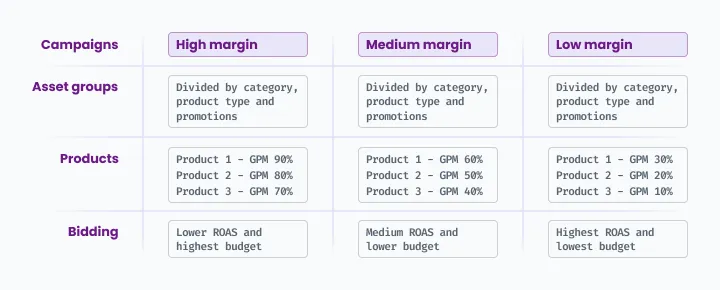
The structure is built on tiers of gross profit margin (GPM%). Each tier gets its own campaign with a specific ROAS target:
High margin products (High GPM%)
Lower ROAS target (still above break-even)
Larger budget to allow higher CPC bids and stronger growth
Medium margin products (Mid GPM%)
Balanced ROAS target
Moderate budget for steady performance
Low margin products (Low GPM%)
Higher ROAS target to control bids and protect profit
Smaller budget, only scale if efficiency is maintained
Example of profit margin campaign structure
Tip: Always set a slightly more ambitious ROAS target than your true minimum. Results fluctuate, and this buffer increases your chance of staying profitable.
Conversion volume matters
Each bucket (high, medium, low) must have enough data for smart bidding. Aim for at least 30 conversions per month per campaign (50+ recommended).
If you don’t have enough conversions, keep one campaign for all products until you reach scale. Splitting too early will hurt algorithm learning.
Google Ads setup
Show me how
Microsoft Ads setup
Show me how
Meta setup
Show me how
(Optional) Setup with GA4 metrics
Show me how
Pro tips from the field
Specialists recommend:
Check margin data carefully: Don’t group products until you’re confident your COGS data is accurate.
Keep buckets meaningful: 2–3 tiers are usually enough (High, Medium, Low). Avoid over-segmentation.
Prioritize high-margin growth: Be more aggressive with bidding and budget for profitable products.
Protect thin margins: Set stricter ROAS targets so you don’t overspend on low-margin items.
Review buckets regularly: Margins can shift due to supplier costs, discounts, or seasonality.
Balance market share vs. profit: Sometimes it makes sense to push lower-margin “entry” products strategically but track them separately.
Got a great strategy? Share it!
Add it to the community library and help fellow marketers level up their campaigns. We’ll share them with your name so others know who inspired them.
Thank you! Your submission has been received!
Oops! Something went wrong while submitting the form.
Coming soon:
Product analytics
Now you can track, compare, and optimize product performance across all your campaigns in one place. Try it out!