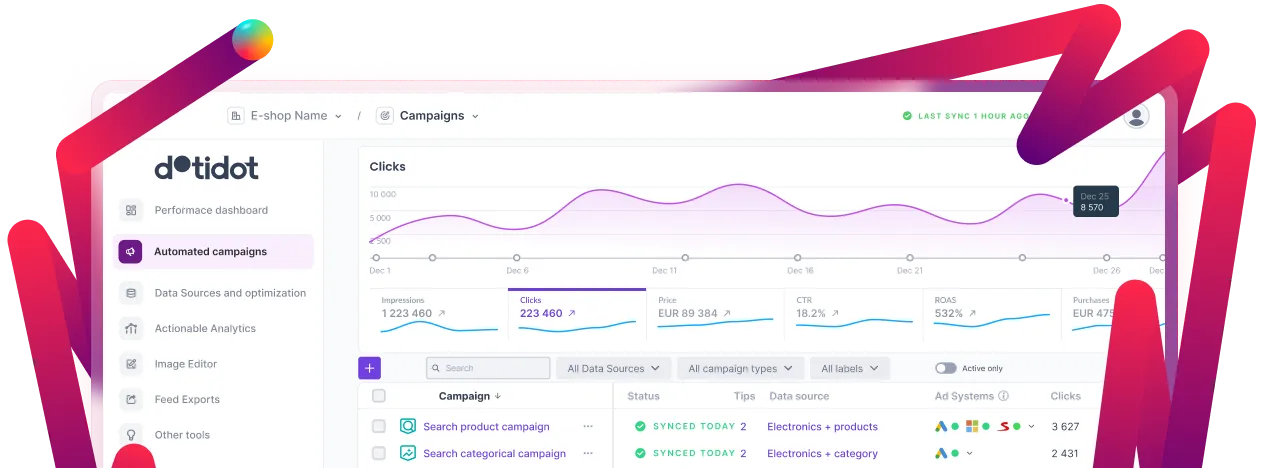
With marketing budgets under intense scrutiny, every dollar of ad spend waste directly erodes profitability. This guide breaks down where inefficiencies hide. From overfunded low-performers to misallocated audiences—and provides a practical framework for identifying, cutting, and reallocating spend to maximize campaign returns.
Where Ad Spend gets wasted
Ad spend waste occurs in predictable patterns that most marketers overlook. The most common culprits include products that receive significant traffic but generate no sales, campaigns that overfund weak performers while starving top sellers, and audiences that click but never convert. Understanding these patterns is the first step toward eliminating budget waste from your campaigns.
In ecommerce advertising, budget waste often happens at the product level. When you manage thousands of SKUs, it becomes nearly impossible to manually track which products consume budget without delivering returns. This creates silent profit leaks that compound over time.
Traffic without sales: The hidden drain
One of the most insidious forms of ad spend waste is paying for traffic that never converts. These are products or ad groups that accumulate clicks—and therefore costs—without generating any revenue. In Performance Max and Shopping campaigns, this often manifests as Zombie products that drain budget while contributing nothing to your bottom line.
Key indicators of traffic without sales include:
- Products with high click volume but zero conversions over 30+ days
- Ad groups where cost-per-acquisition exceeds product margin
- Keywords driving irrelevant traffic that bounces immediately
- Placements on networks that generate impressions but no engagement
Overfunding weak products
Smart bidding algorithms prioritize products that have historical data, which often means they continue funding products that performed well in the past but no longer convert. This creates a cycle where budget flows to established underperformers while promising new products remain underfunded.
The solution requires active product-level monitoring. You need to identify which items consume disproportionate budget relative to their revenue contribution and either fix their performance issues or exclude them from campaigns entirely.
Signs of overfunded Underperformers
- Products spending 10% or more of campaign budget but contributing less than 2% of revenue
- Items with declining ROAS over three consecutive months
- Products where cost-per-click has increased while conversion rate has dropped
Poor audience allocation
Even well-performing products can suffer from budget waste when they target the wrong audiences. Broad targeting might capture impressions, but if those impressions reach users with no purchase intent, your ad spend becomes a sunk cost.
Audience-level waste often appears in remarketing campaigns that retarget all visitors equally, regardless of their engagement level. A visitor who bounced after three seconds deserves different treatment than someone who added items to cart.
Tip: Segment your remarketing audiences by engagement depth. Create separate campaigns for cart abandoners, product viewers, and casual browsers—then allocate budget proportionally to each segment's conversion probability.
Identifying waste with data
Eliminating budget waste requires granular, product-level data analysis. Campaign-level metrics hide the performance variations between individual products. You need visibility into how each SKU performs independently.
Start by connecting your ad platforms with your analytics and ecommerce data. Look for products where:
- Ad spend exceeds gross profit margin
- Click-through rate is high but conversion rate is near zero
- Impression share is high but purchase intent signals are absent
Cutting or fixing underperformers
Once you identify wasteful spend, you have two options: fix the underperformer or cut it entirely. The decision depends on whether the problem is fixable.
When to fix
- Poor product data quality causing low relevance scores
- Missing or inadequate product images
- Uncompetitive pricing that can be adjusted
- Landing page issues affecting conversion
When to cut
- Products with inherently low margins that cannot sustain ad costs
- Items in declining categories with shrinking demand
- Products that consistently underperform despite optimization attempts
Use negative product targets or campaign exclusions to stop budget from flowing to products you decide to cut.
Budget reallocation workflow
Cutting waste is only half the equation. The real profitability gains come from reinvesting recovered budget into proven performers.
A practical reallocation framework follows these steps:
- Calculate total monthly spend on identified underperformers
- Identify your top 20% of products by ROAS or profit contribution
- Determine if top performers are impression-share limited
- Gradually shift budget from underperformers to high-potential products
- Monitor performance weekly during transition
Tip: Do not reallocate all recovered budget immediately. Start with 50% reallocation over two weeks and measure impact before committing the remaining funds. This prevents overcorrection.
Monitoring and ongoing optimization
Budget waste prevention is not a one-time exercise. Product performance shifts with seasonality, competition, and inventory changes. Establish a regular review cadence—weekly for high-spend campaigns, monthly for smaller ones.
Build automated alerts for products that cross waste thresholds. Set rules to pause or reduce bids on items that exceed your cost-per-acquisition limits. Use product segmentation to group SKUs by performance tier and apply different bidding strategies to each segment.
Track these metrics consistently:
- Percentage of budget going to non-converting products
- Average ROAS by product category and tier
- Trend in wasted spend over time
- Budget utilization rate on top performers
Conclusion
Reducing ad spend waste requires shifting from campaign-level thinking to product-level analysis. The inefficiencies that erode profitability hide in the aggregate—products that consume budget without converting, audiences that click without buying, and weak performers that starve your best sellers of resources. By systematically identifying waste, cutting or fixing underperformers, and reallocating budget to proven winners, you transform wasted spend into profitable growth. The discipline of ongoing monitoring ensures these gains compound rather than erode over time.