When your catalog spans 30 categories, one ROAS target isn't enough

Dotidot helps multicategory stores manage massive catalogs, allocate budget across categories with different margins, and stay visible across 50+ channels — without a team to match.

Built for the scale of multicategory retail

€ 124 B
CEE e-commerce market in 2024
+ 12%
Year-over-year market growth
96%
ROAS uplift from margin-based feed segmentation
50+
Channels managed from a single product feed

Every category plays by different rules — your feed tool shouldn't care

Electronics need specs. Fashion needs sizes. Grocery needs expiry dates. Dotidot handles all of them from one master catalog.
What’s happening
A multicategory store carries products across electronics, home, fashion, beauty, toys, and more — each with fundamentally different mandatory attributes. Google’s taxonomy alone has over 6,000 categories to map correctly.
Why it’s a problem
Misaligned taxonomy keeps products out of relevant Shopping contexts and hands that traffic to competitors. Marketing teams spend more time fixing feeds than optimizing campaigns.
Where Dotidot comes in
Dotidot normalizes, enriches, and maps product data across all categories from a single master catalog — structured, complete, and compliant per channel without developer involvement.
What’s happening
Adding a new category means new mandatory attributes, compliance rules, and channel-specific formatting — each requiring separate feed logic. Manual management breaks down once you exceed a handful of categories.
Why it’s a problem
Teams spend more time building feed rules than growing campaigns. Every new product line adds complexity that compounds across every channel.
Where Dotidot comes in
Dotidot lets you build category-specific feed rules, custom attribute mappings, and per-channel transformations that scale automatically as new categories and products enter the catalog.
What’s happening
DataFeedWatch reports 16.66% of all products in advertising catalogs are unavailable for purchase — in sporting goods, that figure reaches 40%. With hundreds of thousands of SKUs, inventory signals get lost.
Why it’s a problem
Ads run for products shoppers can’t buy. Wasted clicks, damaged trust, and budget that should have gone to available inventory.
Where Dotidot comes in
Dotidot monitors inventory in real time and automatically pauses or excludes unavailable products from campaigns, redirecting budget to what’s actually in stock.

50+ channels. Every category has different required fields. You need one team to manage all of it

Google, Meta, Heureka, idealo, Ceneo, Amazon — each wants a different format. Dotidot exports them all from a single source of truth.
What’s happening
Google Shopping, Meta, Amazon, Heureka, idealo, Ceneo, and dozens more each require unique formats, mandatory attributes, and image specs. Stores with 200K+ SKUs promote on 50% more channels than smaller stores.
Why it’s a problem
Feed teams become bottlenecks and errors cascade across channels. Inconsistent data leads to disapprovals, conflicting messaging, and conversion rate damage.
Where Dotidot comes in
Dotidot manages exports to 50+ channels from a single source of truth with 80+ pre-built templates — consistent, optimized product data everywhere, with no duplicate work.
What’s happening
~7% of Google Shopping feed items get rejected due to data errors. Invalid GTINs account for 6% of all submissions. 44% of disapprovals relate to shipping and images — issues that compound across a large catalog.
Why it’s a problem
Products go dark right when shoppers are searching, handing impressions to competitors who stayed compliant.
Where Dotidot comes in
Dotidot’s feed validation catches errors before submission — automatically correcting missing attributes, invalid GTINs, and formatting issues across all channels.
What’s happening
Alza’s team previously needed significant programmer investment just to modify feeds for hundreds of thousands of products across segments. Different CSEs in different countries require unique feed structures.
Why it’s a problem
Expensive technical talent spent on repetitive data manipulation instead of building the business. Tickets pile up and campaigns wait.
Where Dotidot comes in
Dotidot gave Alza’s marketing team full feed control through a visual interface — no code, no tickets, no delays. 20 hours of programmer time saved per month.

Trusted by multicategory teams across Europe.

Using the Dotidot platform has unlocked the full potential of our products and made it much easier to analyze over 100,000 items on a daily basis. The automated creative feature allows us to present our diverse assortment in a simple and effective way. Most importantly, since we started using Dotidot, we have seen a significant improvement in the performance of our META campaigns.
Avatar
Jelena Miličić
Performance Marketing Manager

One ROAS target across 30 categories hides where money is actually made

Electronics margins are thin. Beauty margins are high. Toys peak at Christmas. Garden peaks in June. Dotidot allocates budget per category, not per campaign.
What’s happening
Margins vary dramatically: electronics may need 4–7:1 ROAS to break even while beauty generates profit at 2–3:1. A healthy blended ROAS masks significant inefficiencies in specific segments.
Why it’s a problem
Profitable categories subsidize unprofitable ones and the team has no signal to act on. Budgets grow faster than actual profit.
Where Dotidot comes in
Dotidot enables category-level segmentation with custom ROAS targets and margin-based bidding rules — so every category is held to a standard that reflects its actual economics.
What’s happening
When a heatwave spikes demand for fans while garden furniture stalls, manual budget reallocation takes days. By the time campaigns adjust, the moment has passed.
Why it’s a problem
High-intent traffic goes to faster competitors. Budget sits idle in underperforming categories while peak demand for other categories goes unmet.
Where Dotidot comes in
Dotidot shifts spend dynamically based on real-time signals — inventory levels, conversion velocity, seasonality — across all categories simultaneously, without manual intervention.
What’s happening
When a store expands into a new vertical, those products enter campaigns with zero performance history. Algorithms default to proven bestsellers from established categories.
Why it’s a problem
New categories never gain the visibility needed to build traction. Investment in new verticals yields no return because the algorithm ignores them.
Where Dotidot comes in
Dotidot’s product-level rules proactively boost visibility for new categories from day one — ensuring they receive dedicated budget and build data that feeds future optimization.

Christmas is electronics + toys + home. Summer is garden + sports + beauty. Your campaigns need to handle all of them at once

Multicategory retailers face overlapping seasonal peaks with conflicting budget demands. Dotidot pre-configures rules per category so every season runs on autopilot.
What’s happening
Q4 accounts for up to 32% of annual revenue, with toys generating 33% of yearly sales in October–December alongside electronics, home décor, and gifts — all competing for the same budget. Google Shopping CPCs spike 15–25% in Q4.
Why it’s a problem
Underfunded categories miss their window while overfunded ones hit diminishing returns. Meta CPMs spike 25–60% in November–December, hitting every category simultaneously.
Where Dotidot comes in
Dotidot lets you pre-configure seasonal rules per category — electronics for Black Friday, toys from November, garden in spring — all running simultaneously without manual switching.
What's happening
Shifting from back-to-school to autumn home to Black Friday to Christmas requires updating product images, banners, and overlays across the entire catalog. Manual production at this scale is impossible.
Why it's a problem
Seasonal campaigns launch late and look generic. Lower CTR, missed engagement, creative fatigue — and a team that’s always catching up.
Where Dotidot comes in
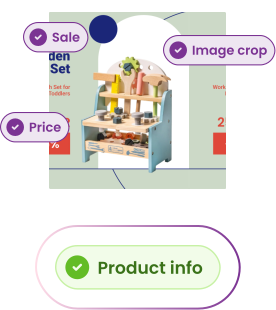
Dotidot’s Image Editor bulk-applies seasonal banners, promotional badges, and price callouts across the entire catalog, no design team needed for every campaign switch.

Trusted by multicategory teams across Europe.

Using the Dotidot platform has unlocked the full potential of our products and made it much easier to analyze over 100,000 items on a daily basis. The automated creative feature allows us to present our diverse assortment in a simple and effective way. Most importantly, since we started using Dotidot, we have seen a significant improvement in the performance of our META campaigns.
Avatar
Jelena Miličić
Performance Marketing Manager

Scale smarter with expert-backed automation. Let’s plan for your growth!

Partner with the team trusted to manage millions in EUR and accelerate your business growth
Book a free 30-minute call with a Dotidot Account Executive.
Get a personalized plan to align your goals and strategies
Launch faster, safer with expert support and no blockers