Boataround cut ad groups by 10× and gave Smart Bidding the data it needed to perform
10 x
less ad groups
Faster
Smart Bidding learning cycles
100 %
correct landing pages per keyword
Boataround is one of Europe's leading boat rental platforms, offering thousands of vessels across multiple destinations worldwide. With a large and constantly changing inventory, managing product-level Search campaigns at scale is a core part of their performance marketing operation.
Services
Global
Challenge:
Boataround's Search campaigns had grown so large they became difficult to manage. With thousands of ad groups collecting data separately, Smart Bidding was struggling to learn and any account change took hours to sync.
Results:
Products grouped into shared ad groups based on category or destination
Every keyword still points to its own correct landing page automatically
Bestsellers and high-value products kept in individual ad groups for full control
Long-tail products consolidated into groups, giving Smart Bidding enough data to learn faster
Fallback URLs ensure no keyword is ever left without a destination
Running Search campaigns for a large product catalog sounds straightforward. Until the account grows so big it becomes impossible to manage. Boataround reached a point where their campaign structure was working against them. Sync times stretched to hours and Smart Bidding was struggling to learn.
Dotidot solved this with a new approach to Search campaign structure: One that consolidates ad groups at scale while making sure every single keyword still points to the correct product page.
About the client
Boataround was founded in 2016 with a simple idea: renting a boat should be as easy as booking a hotel room. The company was started by Jana Escher and Pavel Pribiš, both former employees of Booking.com, who wanted to bring the same transparency and simplicity to the boat rental market. Today, Boataround operates in 72 countries and manages one of the largest inventories of sailboats, motorboats, and catamarans available for charter worldwide. Starting from a single contract for 17 vessels at a Croatian resort, the company has grown into the number two boat rental operator in Europe and one of the top five platforms in the world. With an inventory spanning thousands of unique listings across dozens of destinations, managing product-level Search campaigns at scale is not just a technical challenge.
Challenge
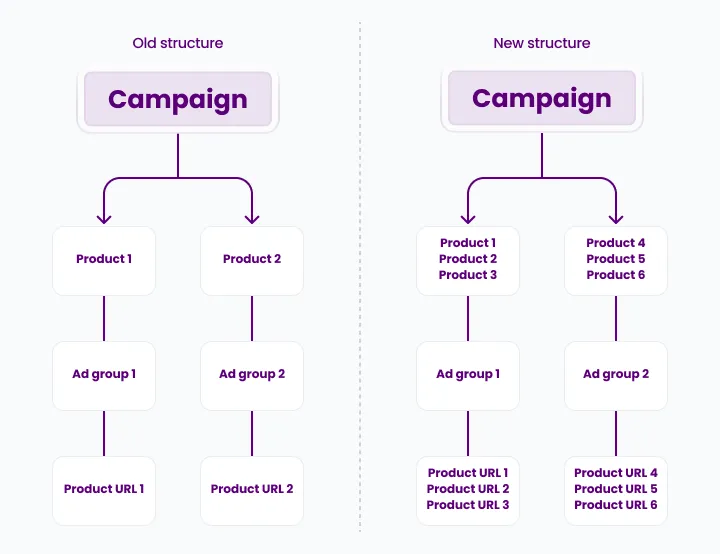
Large e-commerce and inventory-based advertisers using Search campaigns in Dotidot traditionally follow a 1 product = 1 ad group structure. It gives full control and precise ad copy, but as catalogs grow, it creates a compounding problem.
Boataround were dealing with all three consequences at once. Their account had grown to a point where the sheer number of ad groups was approaching Google's hard limit of around 20,000 per campaign. Any change to the account took hours to sync, making real-time optimization nearly impossible. And with thousands of ad groups each collecting their own conversion data, most individual ad groups never accumulated enough conversions for Smart Bidding to learn properly, leaving performance fragmented and unpredictable across the long tail of the catalog.
As Boataround put it directly: accounts with hundreds of thousands of ad groups are impossible to handle. The data is so fragmented that Smart Bidding simply cannot do its job.
Solution: Strategy switch and new feature
1/ Consolidating ad groups without losing landing page accuracy
The core problem with consolidation has always been a simple one: if you group multiple products into a single ad group, all their keywords point to the same landing page. For an inventory-based business like Boataround, sending a user searching for a specific boat in a specific location to a generic page is not acceptable.
Dotidot's new keyword-level Final URL support solved this directly. Products are grouped into shared ad groups based on a feed attribute: category, destination, or a custom grouping field. Each individual keyword still maps to its own specific landing page. The platform generates keywords to URL pairs automatically, with a fallback URL at the ad level to catch any gaps. The result is a dramatically simpler account structure with zero compromise on landing page relevance.
2/ A hybrid structure that keeps control where it matters
Consolidation is not the right approach for every product. The strategy Dotidot recommends and the one applied for Boataround combines both structures deliberately:
Individual ad groups for bestsellers, high-margin products, and anything with high individual search volume. These stay granular for maximum control over ad copy and bidding precision.
Grouped ad groups with keyword-level URLs for long-tail products, variants, and lower-volume inventory. These accumulate conversion data at the group level, giving Smart Bidding the signal density it needs to optimize effectively.
This hybrid approach means the algorithm gets enough data to learn on the long tail, while the most valuable products retain full individual-level control.
Results
10× fewer ad groups for long-tail products: Bringing the account structure from unmanageable to clean and navigable without losing any landing page accuracy.
Faster Smart Bidding learning cycles: Consolidated ad groups accumulate conversion data significantly faster, reducing the time campaigns spend in the learning phase and improving ROAS on the long tail.
Hours saved on sync and maintenance: Fewer ad groups means changes sync faster and routine maintenance takes a fraction of the previous time, freeing the team for strategic work instead.
100% correct landing pages per keyword: Despite the consolidation, every keyword still points to the exact right product or listing page. No generic landing pages, no lost relevance.
What this means for large catalogs
The 1 product = 1 ad group approach made sense when accounts were smaller. At scale, it becomes the thing holding performance back. Boataround's case shows that consolidation done correctly, delivers cleaner structure, faster learning, and better performance across the full catalog.
Not as a workaround. As a native, scalable solution built into the platform.
Boataround cut ad groups by 10× and gave Smart Bidding the data it needed to perform
Services
June 16, 2026
Summary
10 x
less ad groups
Faster
Smart Bidding learning cycles
100 %
correct landing pages per keyword
Challenge
Boataround's Search campaigns had grown so large they became difficult to manage. With thousands of ad groups collecting data separately, Smart Bidding was struggling to learn and any account change took hours to sync.
Who is Boataround?
Boataround is one of Europe's leading boat rental platforms, offering thousands of vessels across multiple destinations worldwide. With a large and constantly changing inventory, managing product-level Search campaigns at scale is a core part of their performance marketing operation.
Boataround's Search campaigns had grown so large they became difficult to manage. With thousands of ad groups collecting data separately, Smart Bidding was struggling to learn and any account change took hours to sync.
Results
Products grouped into shared ad groups based on category or destination
Every keyword still points to its own correct landing page automatically
Bestsellers and high-value products kept in individual ad groups for full control
Long-tail products consolidated into groups, giving Smart Bidding enough data to learn faster
Fallback URLs ensure no keyword is ever left without a destination
Running Search campaigns for a large product catalog sounds straightforward. Until the account grows so big it becomes impossible to manage. Boataround reached a point where their campaign structure was working against them. Sync times stretched to hours and Smart Bidding was struggling to learn.
Dotidot solved this with a new approach to Search campaign structure: One that consolidates ad groups at scale while making sure every single keyword still points to the correct product page.
About the client
Boataround was founded in 2016 with a simple idea: renting a boat should be as easy as booking a hotel room. The company was started by Jana Escher and Pavel Pribiš, both former employees of Booking.com, who wanted to bring the same transparency and simplicity to the boat rental market. Today, Boataround operates in 72 countries and manages one of the largest inventories of sailboats, motorboats, and catamarans available for charter worldwide. Starting from a single contract for 17 vessels at a Croatian resort, the company has grown into the number two boat rental operator in Europe and one of the top five platforms in the world. With an inventory spanning thousands of unique listings across dozens of destinations, managing product-level Search campaigns at scale is not just a technical challenge.
Challenge
Large e-commerce and inventory-based advertisers using Search campaigns in Dotidot traditionally follow a 1 product = 1 ad group structure. It gives full control and precise ad copy, but as catalogs grow, it creates a compounding problem.
Boataround were dealing with all three consequences at once. Their account had grown to a point where the sheer number of ad groups was approaching Google's hard limit of around 20,000 per campaign. Any change to the account took hours to sync, making real-time optimization nearly impossible. And with thousands of ad groups each collecting their own conversion data, most individual ad groups never accumulated enough conversions for Smart Bidding to learn properly, leaving performance fragmented and unpredictable across the long tail of the catalog.
As Boataround put it directly: accounts with hundreds of thousands of ad groups are impossible to handle. The data is so fragmented that Smart Bidding simply cannot do its job.
Solution: Strategy switch and new feature
1/ Consolidating ad groups without losing landing page accuracy
The core problem with consolidation has always been a simple one: if you group multiple products into a single ad group, all their keywords point to the same landing page. For an inventory-based business like Boataround, sending a user searching for a specific boat in a specific location to a generic page is not acceptable.
Dotidot's new keyword-level Final URL support solved this directly. Products are grouped into shared ad groups based on a feed attribute: category, destination, or a custom grouping field. Each individual keyword still maps to its own specific landing page. The platform generates keywords to URL pairs automatically, with a fallback URL at the ad level to catch any gaps. The result is a dramatically simpler account structure with zero compromise on landing page relevance.
2/ A hybrid structure that keeps control where it matters
Consolidation is not the right approach for every product. The strategy Dotidot recommends and the one applied for Boataround combines both structures deliberately:
Individual ad groups for bestsellers, high-margin products, and anything with high individual search volume. These stay granular for maximum control over ad copy and bidding precision.
Grouped ad groups with keyword-level URLs for long-tail products, variants, and lower-volume inventory. These accumulate conversion data at the group level, giving Smart Bidding the signal density it needs to optimize effectively.
This hybrid approach means the algorithm gets enough data to learn on the long tail, while the most valuable products retain full individual-level control.
Results
10× fewer ad groups for long-tail products: Bringing the account structure from unmanageable to clean and navigable without losing any landing page accuracy.
Faster Smart Bidding learning cycles: Consolidated ad groups accumulate conversion data significantly faster, reducing the time campaigns spend in the learning phase and improving ROAS on the long tail.
Hours saved on sync and maintenance: Fewer ad groups means changes sync faster and routine maintenance takes a fraction of the previous time, freeing the team for strategic work instead.
100% correct landing pages per keyword: Despite the consolidation, every keyword still points to the exact right product or listing page. No generic landing pages, no lost relevance.
What this means for large catalogs
The 1 product = 1 ad group approach made sense when accounts were smaller. At scale, it becomes the thing holding performance back. Boataround's case shows that consolidation done correctly, delivers cleaner structure, faster learning, and better performance across the full catalog.
Not as a workaround. As a native, scalable solution built into the platform.