This global retailer reduced budget waste by 63% and scaled revenue with smarter product segmentation
63%
lower budget waste on underperforming products
51%
fewer promoted products with negative ROAS
16%
more products actively promoted
The client is one of the world’s largest sporting goods retailers. The company offers equipment, clothing, and accessories for many sports categories. It ooperates both online and offline stores, but their e-commerce business plays a key role in overall growth.
Multicategory
Sport
Global
Challenge:
The main objective was to increase total revenue while keeping overall efficiency under control. At the same time, Search campaigns needed to be scaled without lowering ROAS. Additionally, it was necessary to identify and eliminate product-level budget inefficiencies within Performance Max to ensure that scaling would not amplify existing structural issues.
Results:
63% lower budget waste on underperforming products
51% fewer promoted products with negative ROAS
16% more products actively promoted
89% lower budget concentration across the portfolio
Performance Max revenue increased by 15% with 7% higher spend
Search campaigns scaled up by 104% in spend and 108% in revenue
Managing thousands of products in Performance Max often leads to budget imbalance. Some products take most of the spend, others get no visibility, and waste increases. At the same time, scaling Search campaigns without losing control is not easy.
Can you reduce waste, improve product coverage, and scale both Performance Max and Search efficiently? One of our clients proved that you can.
About the client
The client is one of the world’s largest sporting goods retailers, designing and selling equipment, clothing, and accessories across dozens of sports categories. The company operates both physical stores and a strong e-commerce platform. Due to a wide and diverse product catalog, campaign structure and automation are critical to maintaining scalable performance.
Challenge
A detailed audit via Product Analytics (focused on Shopping & Performance Max data) uncovered structural inefficiencies in product-level budget allocation. The data showed:
A small percentage of products consumed most of the budget
Many products were not promoted at all
Several promoted products were not meeting target ROAS
This created a risky situation. Budget concentration was high, product coverage was low, and scaling could easily reduce efficiency.
The client’s goal was clear: Increase total revenue and scale campaigns, but keep the ROAS effectivity as it is or better.
Without restructuring, scaling would only amplify existing inefficiencies.
The strategy: Restructure both Performance Max and Search
The solution was not about increasing budgets. It was about smarter segmentation and better distribution. The strategy focused on two main pillars:
Product-level restructuring in Performance Max
Scalable expansion of Search campaigns
1/ Performance Max: Smarter product segmentation based on ROAS
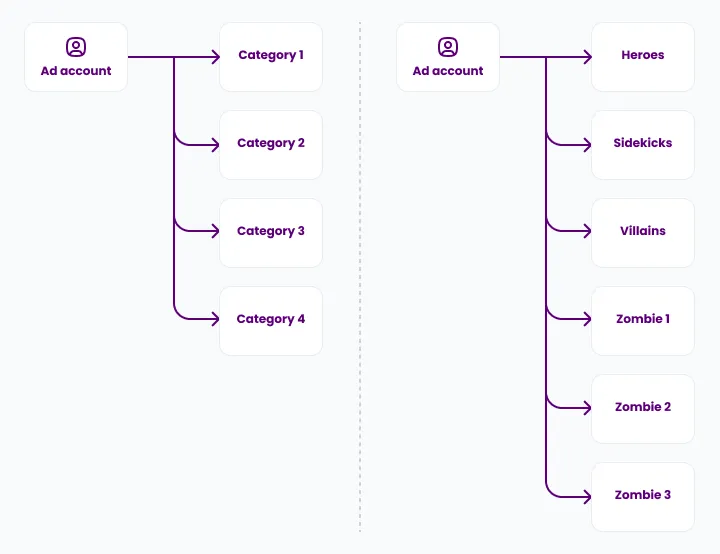
Originally, the account had three Performance Max campaigns divided by product categories. While simple, this structure did not reflect real product performance.
A new segmentation model based on a ROAS Product Strategy was introduced. Products were grouped according to ROAS and click performance into clear brackets:
Heroes: High clicks, strong ROAS, or strategically important products
Sidekicks: Moderate clicks with stable, healthy ROAS
Villains: High traffic but not meeting target ROAS
Zombies: Several campaigns for underperforming or “dead” products divided further by click and ROAS logic
Comparison of old (left) and new (right) structure
This structure changed budget logic completely. Instead of letting Google distribute spend across categories blindly, allocation became performance-driven at product level. Underperformers were controlled. Profitable products gained visibility. Scaling became predictable.
Performance Max was then safely slightly expanded: +7% spend, +15% revenue growth
Revenue grew faster than spend which means that scaling did not damage efficiency.
2/ Search expansion: Unlocking additional growth
While Performance Max was optimized using ROAS-based product segmentation, Search was rebuilt structurally for scale and coverage expansion.
Category Search campaigns
Campaigns were created for all strategically important categories:
Categories were automatically scraped from the sitemap to ensure complete and accurate coverage.
Non-priority categories were excluded to keep structure focused.
Category Ads included dynamic information such as number of products in category and minimum price of a product.
Keywords were generated dynamically based on the category title
Additional keywords were added based on SEO research, increasing query coverage
This significantly expanded reach while maintaining control.
Product-level Search via DSA
Dynamic Search Ads (DSA) were implemented to cover product-level searches. Instead of manually building thousands of keywords, automation handled large-scale coverage while maintaining performance monitoring.
Both strategies allowed Search campaigns to grow aggressively without increasing operational complexity. The result was strong and controlled growth with spend growing by 104% and revenue by 108%.
3/ Bonus: Data Scraper and ChatBot integration
To further improve customer experience, client used Dotidot to scrape data they did not have in their feeds yet. They extracted detailed product attributes such as weight, size, usage and other parameters or technical specifications.
This enriched data was exported to a ChatBot system, which now uses it to recommend relevant products in real time.
This way, client’s team connected performance marketing with customer support. Wow!
This global retailer reduced budget waste by 63% and scaled revenue with smarter product segmentation
Sport
February 24, 2026
Summary
63%
lower budget waste on underperforming products
51%
fewer promoted products with negative ROAS
16%
more products actively promoted
Challenge
The main objective was to increase total revenue while keeping overall efficiency under control. At the same time, Search campaigns needed to be scaled without lowering ROAS. Additionally, it was necessary to identify and eliminate product-level budget inefficiencies within Performance Max to ensure that scaling would not amplify existing structural issues.
Who is Global sports retailer?
The client is one of the world’s largest sporting goods retailers. The company offers equipment, clothing, and accessories for many sports categories. It ooperates both online and offline stores, but their e-commerce business plays a key role in overall growth.
+ X more countries
Using Dotidot since 2025
Challenge
The main objective was to increase total revenue while keeping overall efficiency under control. At the same time, Search campaigns needed to be scaled without lowering ROAS. Additionally, it was necessary to identify and eliminate product-level budget inefficiencies within Performance Max to ensure that scaling would not amplify existing structural issues.
Results
63% lower budget waste on underperforming products
51% fewer promoted products with negative ROAS
16% more products actively promoted
89% lower budget concentration across the portfolio
Performance Max revenue increased by 15% with 7% higher spend
Search campaigns scaled up by 104% in spend and 108% in revenue
Managing thousands of products in Performance Max often leads to budget imbalance. Some products take most of the spend, others get no visibility, and waste increases. At the same time, scaling Search campaigns without losing control is not easy.
Can you reduce waste, improve product coverage, and scale both Performance Max and Search efficiently? One of our clients proved that you can.
About the client
The client is one of the world’s largest sporting goods retailers, designing and selling equipment, clothing, and accessories across dozens of sports categories. The company operates both physical stores and a strong e-commerce platform. Due to a wide and diverse product catalog, campaign structure and automation are critical to maintaining scalable performance.
Challenge
A detailed audit via Product Analytics (focused on Shopping & Performance Max data) uncovered structural inefficiencies in product-level budget allocation. The data showed:
A small percentage of products consumed most of the budget
Many products were not promoted at all
Several promoted products were not meeting target ROAS
This created a risky situation. Budget concentration was high, product coverage was low, and scaling could easily reduce efficiency.
The client’s goal was clear: Increase total revenue and scale campaigns, but keep the ROAS effectivity as it is or better.
Without restructuring, scaling would only amplify existing inefficiencies.
The strategy: Restructure both Performance Max and Search
The solution was not about increasing budgets. It was about smarter segmentation and better distribution. The strategy focused on two main pillars:
Product-level restructuring in Performance Max
Scalable expansion of Search campaigns
1/ Performance Max: Smarter product segmentation based on ROAS
Originally, the account had three Performance Max campaigns divided by product categories. While simple, this structure did not reflect real product performance.
A new segmentation model based on a ROAS Product Strategy was introduced. Products were grouped according to ROAS and click performance into clear brackets:
Heroes: High clicks, strong ROAS, or strategically important products
Sidekicks: Moderate clicks with stable, healthy ROAS
Villains: High traffic but not meeting target ROAS
Zombies: Several campaigns for underperforming or “dead” products divided further by click and ROAS logic
Comparison of old (left) and new (right) structure
This structure changed budget logic completely. Instead of letting Google distribute spend across categories blindly, allocation became performance-driven at product level. Underperformers were controlled. Profitable products gained visibility. Scaling became predictable.
Performance Max was then safely slightly expanded: +7% spend, +15% revenue growth
Revenue grew faster than spend which means that scaling did not damage efficiency.
2/ Search expansion: Unlocking additional growth
While Performance Max was optimized using ROAS-based product segmentation, Search was rebuilt structurally for scale and coverage expansion.
Category Search campaigns
Campaigns were created for all strategically important categories:
Categories were automatically scraped from the sitemap to ensure complete and accurate coverage.
Non-priority categories were excluded to keep structure focused.
Category Ads included dynamic information such as number of products in category and minimum price of a product.
Keywords were generated dynamically based on the category title
Additional keywords were added based on SEO research, increasing query coverage
This significantly expanded reach while maintaining control.
Product-level Search via DSA
Dynamic Search Ads (DSA) were implemented to cover product-level searches. Instead of manually building thousands of keywords, automation handled large-scale coverage while maintaining performance monitoring.
Both strategies allowed Search campaigns to grow aggressively without increasing operational complexity. The result was strong and controlled growth with spend growing by 104% and revenue by 108%.
3/ Bonus: Data Scraper and ChatBot integration
To further improve customer experience, client used Dotidot to scrape data they did not have in their feeds yet. They extracted detailed product attributes such as weight, size, usage and other parameters or technical specifications.
This enriched data was exported to a ChatBot system, which now uses it to recommend relevant products in real time.
This way, client’s team connected performance marketing with customer support. Wow!