Budget allocation strategies to maximize product-level ROI



The budget allocation problem
Traditional PPC management focuses on campaign-level metrics—total spend, overall ROAS, and aggregate conversion rates. While this approach provides a high-level view, it masks critical performance variations happening at the product level. A campaign might show healthy returns overall, but dig deeper and you'll often find that 20% of products generate 80% of revenue while the rest drain budget without meaningful returns.
This creates a fundamental problem: when you allocate budget to campaigns rather than products, you're essentially averaging out performance across winners and losers. High-potential products get starved of spend while underperformers continue consuming resources. The result is predictable and suboptimal ROI and missed growth opportunities.
Campaign vs product-level budgeting
Campaign-level budgeting treats all products within a campaign equally. If you set a daily budget of €500 for a Shopping campaign, Google's algorithm distributes that spend based on its own optimization signals—which may or may not align with your business priorities.
Product-level budget allocation takes a different approach:
- It recognizes that each product has unique performance characteristics
- It allows you to direct more spend toward proven performers
- It creates controlled environments for testing new or uncertain products
- It enables strategic investment based on margin, seasonality, and inventory
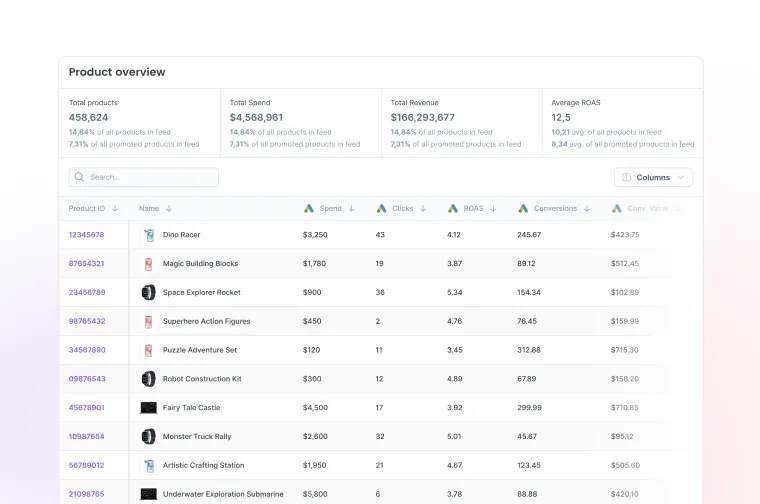
The shift from campaign to product-level thinking requires better data infrastructure and more granular control mechanisms. This is where product segmentation becomes essential—grouping products by performance tiers, margins, or strategic importance so you can allocate budget with precision.
Identifying high-ROI products
Before you can allocate budget effectively, you need to identify which products actually deserve more investment. This requires looking beyond surface-level metrics to understand true profitability.
Key metrics for product performance
- ROAS (Return on Ad Spend): The baseline measure, but don't stop here
- Contribution margin: Revenue minus all variable costs including ad spend
- Conversion rate: Products that convert well often scale efficiently
- Customer lifetime value: Some products attract high-value repeat buyers
- Impression share: Indicates headroom for scaling
Performance tiers
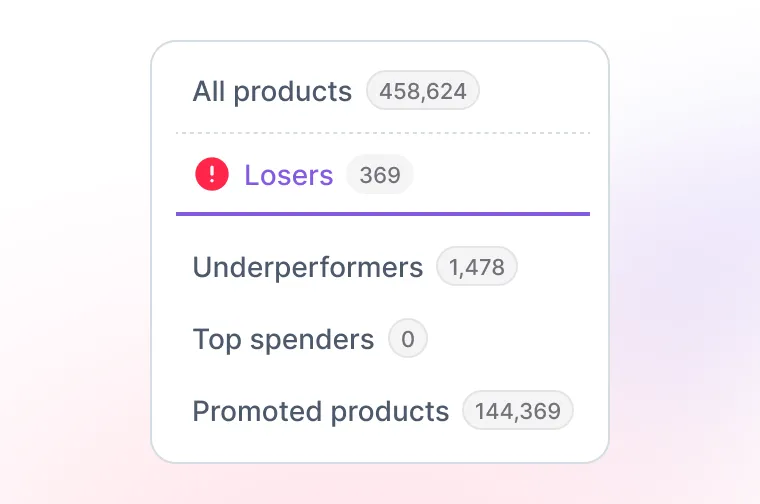
Segment your catalog into clear performance categories. A common framework includes top performers (high volume, high ROAS), steady performers (consistent but modest returns), emerging products (limited data but promising signals), and underperformers (high spend, poor returns).
Tip: Don't just look at the last 30 days. Analyze at least 90 days of data to account for seasonality and promotional periods. Products that appear average might actually be strong performers outside of sale events.
Balancing growth and stability
A smart budget allocation strategy balances two competing priorities: maximizing returns from proven products while investing in growth opportunities.
The temptation is to funnel all budget toward your best performers. But this approach has limits. Top products often hit diminishing returns as you increase spend—CPCs rise, impression share maxes out, and ROAS drops. Meanwhile, potential winners in your catalog never get the exposure needed to prove themselves.
The 70-20-10 Framework
Consider allocating your PPC budget using a tiered approach:
- 70% to proven performers: These products have demonstrated consistent ROI and should receive the bulk of your investment
- 20% to stable products: Solid performers that maintain baseline profitability and provide portfolio diversification
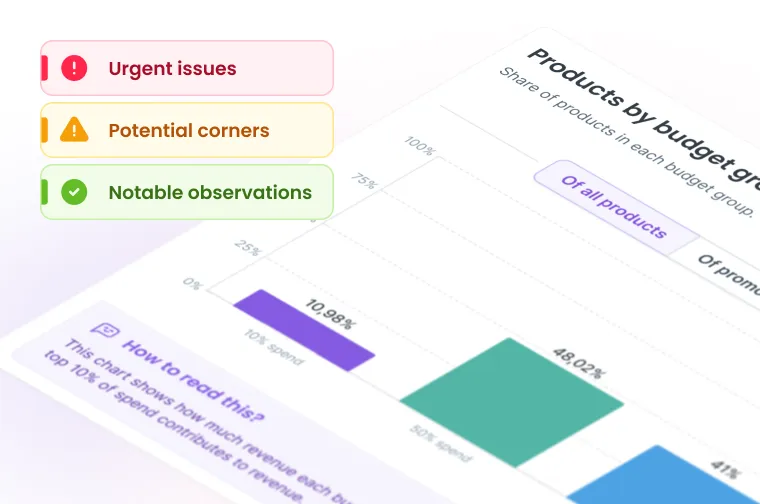
- 10% to testing and emerging products: Controlled investment to identify the next wave of winners
This framework ensures you're maximizing current revenue while building future growth. The exact percentages should flex based on your business stage, competitive dynamics, and risk tolerance.
Intelligent testing budgets
Testing is where most budget allocation strategies fail. Brands either test too aggressively (burning money on unproven products) or too conservatively (never discovering hidden opportunities).
Effective testing requires structure. Define clear success criteria before allocating budget. Set time boundaries—a product should prove itself within a reasonable window or face reduced spend. Monitor early signals like click-through rate and engagement before conversion data becomes statistically significant.
For products in Performance Max campaigns, understanding Zombie products is crucial. These are items that consume impressions but generate zero or minimal clicks, effectively wasting budget that could go to better performers.
Testing protocol
- Define minimum spend thresholds for statistical validity
- Set maximum test duration (typically 2-4 weeks)
- Establish go/no-go criteria before testing begins
- Document learnings regardless of outcome
Reallocation framework
Budget reallocation shouldn't happen randomly or based on gut feel. You need a systematic framework that triggers movement of spend based on defined conditions.
When to increase budget
- Product consistently exceeds ROAS target with available impression share headroom
- Seasonal demand increases for specific product categories
- Inventory levels support increased sales velocity
- Competitive landscape shifts in your favor
When to decrease budget
- ROAS falls below profitability threshold for consecutive periods
- Inventory constraints limit ability to fulfill orders
- Competitive intensity drives CPCs beyond sustainable levels
- Product reaches end of lifecycle or seasonal relevance
Tip: Build reallocation triggers into your workflow. Rather than manually reviewing performance weekly, set up automated alerts when products cross defined thresholds. This enables faster response times and reduces the risk of wasted spend.
Monitoring and adjustments
Product-level budget allocation requires ongoing monitoring. Performance shifts constantly based on competitor activity, seasonal patterns, and algorithm changes.
Establish a regular review cadence:
- Daily: Check for anomalies—sudden spend spikes, performance drops, or disapproved products
- Weekly: Review performance by tier and adjust allocations within the framework
- Monthly: Reassess tier assignments and update strategy based on trends
- Quarterly: Evaluate overall framework effectiveness and refine approach
Use PPC automation tools to handle routine monitoring and surface actionable insights. Manual oversight of thousands of products isn't sustainable, and automation ensures nothing slips through the cracks.
Building a scalable budget model
As your catalog grows, manual budget allocation becomes impossible. A scalable model relies on rules, automation, and clear governance.
Want report like this? Try it for free

Components of a scalable model
- Automated product segmentation based on performance data
- Rules-based budget allocation tied to performance tiers
- Dynamic adjustment mechanisms that respond to real-time signals
- Exception handling for strategic priorities that override standard rules
The goal is to create a system that makes intelligent allocation decisions at scale while preserving human oversight for strategic choices. Technology handles the volume; you handle the strategy.
Conclusion
Effective budget allocation moves beyond campaign-level thinking to recognize that products are the true units of performance. By identifying high-ROI products, creating balanced allocation frameworks, and building systematic reallocation processes, you can significantly improve the efficiency of your PPC spend. The brands that master product-level budget allocation don't just optimize—they compound their advantages over time, directing resources precisely where they generate the greatest returns.

'%3e%3cpath%20d='M20.5%2010.9971C20.5%205.47422%2016.0229%200.99707%2010.5%200.99707C4.97715%200.99707%200.5%205.47422%200.5%2010.9971C0.5%2015.9883%204.15684%2020.1254%208.9375%2020.8756V13.8877H6.39844V10.9971H8.9375V8.79395C8.9375%206.2877%2010.4305%204.90332%2012.7146%204.90332C13.8084%204.90332%2014.9531%205.09863%2014.9531%205.09863V7.55957H13.6922C12.45%207.55957%2012.0625%208.33047%2012.0625%209.12207V10.9971H14.8359L14.3926%2013.8877H12.0625V20.8756C16.8432%2020.1254%2020.5%2015.9883%2020.5%2010.9971Z'%20fill='%2398A2B3'/%3e%3cpath%20d='M14.3926%2013.8877L14.8359%2010.9971H12.0625V9.12207C12.0625%208.33125%2012.45%207.55957%2013.6922%207.55957H14.9531V5.09863C14.9531%205.09863%2013.8088%204.90332%2012.7146%204.90332C10.4305%204.90332%208.9375%206.2877%208.9375%208.79395V10.9971H6.39844V13.8877H8.9375V20.8756C9.97287%2021.0376%2011.0271%2021.0376%2012.0625%2020.8756V13.8877H14.3926Z'%20fill='white'/%3e%3c/g%3e%3cdefs%3e%3cclipPath%20id='clip0_6932_3540'%3e%3crect%20width='20'%20height='20'%20fill='white'%20transform='translate(0.5%200.99707)'/%3e%3c/clipPath%3e%3c/defs%3e%3c/svg%3e)
'%3e%3cpath%20d='M19.0236%200.99707H1.97639C1.58483%200.99707%201.2093%201.15262%200.932425%201.42949C0.655548%201.70637%200.5%202.0819%200.5%202.47346V19.5207C0.5%2019.9122%200.655548%2020.2878%200.932425%2020.5646C1.2093%2020.8415%201.58483%2020.9971%201.97639%2020.9971H19.0236C19.4152%2020.9971%2019.7907%2020.8415%2020.0676%2020.5646C20.3445%2020.2878%2020.5%2019.9122%2020.5%2019.5207V2.47346C20.5%202.0819%2020.3445%201.70637%2020.0676%201.42949C19.7907%201.15262%2019.4152%200.99707%2019.0236%200.99707ZM6.46111%2018.0346H3.45417V8.48318H6.46111V18.0346ZM4.95556%207.15957C4.61447%207.15765%204.2816%207.05473%203.99895%206.86381C3.71629%206.67289%203.49653%206.40251%203.3674%206.08681C3.23826%205.77111%203.20554%205.42423%203.27336%205.08995C3.34118%204.75567%203.5065%204.44897%203.74846%204.20855C3.99042%203.96814%204.29818%203.80479%204.63289%203.73912C4.9676%203.67345%205.31426%203.7084%205.62913%203.83956C5.94399%203.97072%206.21295%204.19221%206.40205%204.47608C6.59116%204.75995%206.69194%205.09348%206.69167%205.43457C6.69488%205.66293%206.65209%205.8896%206.56584%206.10107C6.47959%206.31254%206.35165%206.50449%206.18964%206.66546C6.02763%206.82643%205.83487%206.95314%205.62285%207.03803C5.41083%207.12292%205.18389%207.16425%204.95556%207.15957ZM17.5444%2018.0429H14.5389V12.8248C14.5389%2011.286%2013.8847%2010.811%2013.0403%2010.811C12.1486%2010.811%2011.2736%2011.4832%2011.2736%2012.8637V18.0429H8.26667V8.49013H11.1583V9.81374H11.1972C11.4875%209.22624%2012.5042%208.22207%2014.0556%208.22207C15.7333%208.22207%2017.5458%209.2179%2017.5458%2012.1346L17.5444%2018.0429Z'%20fill='%2398A2B3'/%3e%3c/g%3e%3cdefs%3e%3cclipPath%20id='clip0_6932_1908'%3e%3crect%20width='20'%20height='20'%20fill='white'%20transform='translate(0.5%200.99707)'/%3e%3c/clipPath%3e%3c/defs%3e%3c/svg%3e)