ChatGPT Ads Manager is here and advertisers are already testing it
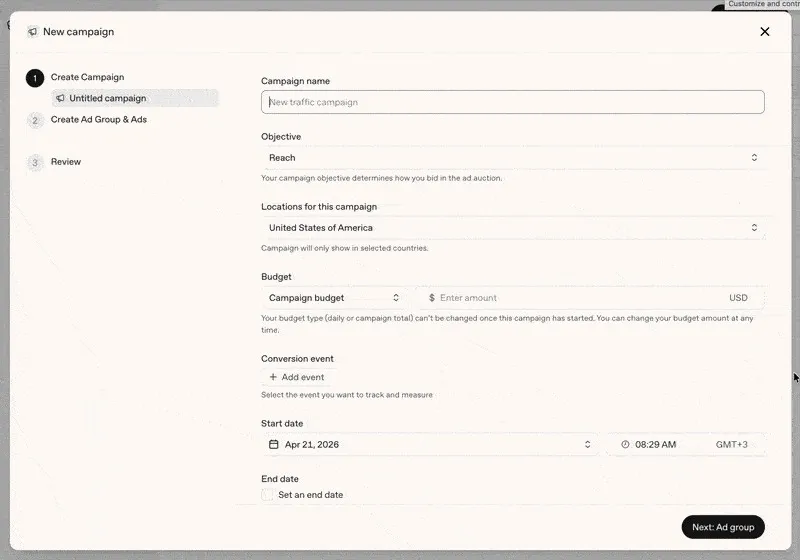
This week, screenshots surfaced showing that OpenAI is testing a fully functional Ads Manager for ChatGPT, a self-serve dashboard where marketers can create campaigns, set bids, choose objectives, and monitor performance in real time.
Marek Turnhofer
April 23, 2026
Show table of contents
From CSV files to a real dashboard
Until very recently, the ChatGPT Shopping experience was like the old ages. Advertisers participating in the pilot program reportedly received basic performance data via weekly CSV files, a far cry from the live dashboards professionals expect from Google Ads or Meta. That era appears to be ending.
Digital marketers Juozas Kaziukėnas and Glenn Gabe were among the first to share visuals of what the new interface looks like in practice. The dashboard gives advertisers the ability to run, monitor, and optimize campaigns in real time.
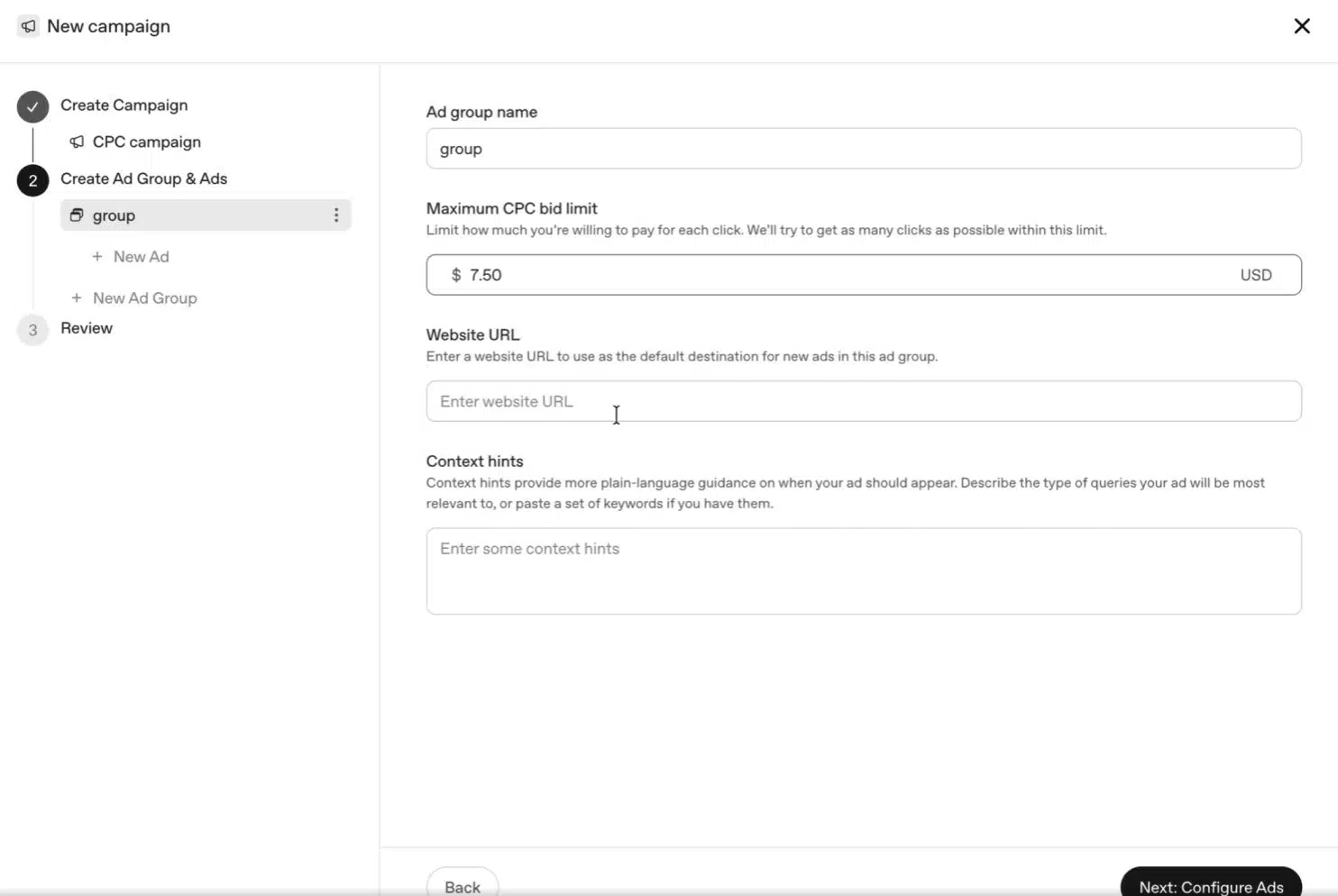
The interface allows advertisers to choose between two campaign objectives, Reach or Clicks, and then enter a maximum CPC bid. The suggested bid range sits between $3 and $5, a figure that has already sparked discussion in the industry.
CPC bidding lowers the entry point requirements
The introduction of cost-per-click pricing is more than a feature update. It's a strategic pivot. Until this point, ChatGPT's ad pilot has operated on a CPM (cost-per-thousand-impressions) basis, appealing primarily to brand advertisers with large budgets. CPM pricing at launch reportedly ranged from $15 to $60, with a minimum spend commitment of $250,000.
Those numbers have come down considerably. CPMs have reportedly dropped to as low as $25 in some cases, and the minimum spend threshold has fallen from $250,000 to $50,000. Now, with CPC bidding entering the picture, OpenAI is opening the door to a completely different type of advertiser: the performance marketer.
Performance marketers, who account for the majority of online ad spend, prefer to pay for clicks rather than impressions. Adding CPC bidding is effectively an invitation for this much larger buyer category to join the platform. The $3 to $5 range may feel arbitrary (and some advertisers have noted it may not be competitive enough in certain verticals), but it establishes a framework that can evolve as the platform matures.
OpenAI's tracking pixel is now live
Alongside the Ads Manager news, Kaziukėnas reported that OpenAI has also launched a tracking pixel for ChatGPT ads, a development that deserves equal attention. Conversion tracking is foundational infrastructure for any performance ad network. Without it, advertisers are flying blind after the click.
The pixel connects user behavior on websites and apps back to an ad click, enabling proper reporting and, eventually, conversion-optimized campaigns. Notably, its syntax is reportedly nearly identical to Facebook's pixel, a deliberate choice that lowers the barrier for the enormous base of advertisers already running Meta campaigns.
Early users are already using it
The infrastructure isn't just theoretical. Real brands are already appearing in ChatGPT. Early reports have spotted names like Best Buy and Expedia in the platform's initial ad tests. The combination of growing inventory, a new self-serve interface, CPC pricing, and conversion tracking suggests OpenAI is trying to compress the typical multi-year ad platform build into a matter of months.
What this means for advertisers
For PPC professionals and performance marketers, the key takeaways are:
It's becoming accessible. The drop in minimum spend from $250,000 to $50,000, combined with self-serve tools and CPC bidding, means ChatGPT advertising is no longer exclusively a large-budget brand play.
Measurement is coming. The tracking pixel is the infrastructure that makes performance campaigns viable. Its similarity to Facebook's pixel means your existing setup knowledge transfers.
The platform is still early. The ads manager is in testing, not full rollout. Some reporting features remain limited, and the $3 to $5 CPC range will likely shift as more advertisers enter the auction. Now is the time to learn, not necessarily to scale.
Intent-driven context is different. Users on ChatGPT are actively asking questions and seeking specific answers. That's a different advertising context than scrolling a social feed, and potentially a very valuable one for the right categories.
The bottom line
ChatGPT's advertising platform is evolving faster than most people expected. From impression-only CPM deals to a self-serve Ads Manager with CPC bidding and a conversion tracking pixel, all within the span of a few months, OpenAI is compressing the development timeline that took Google Ads and Meta years to build.
Whether ChatGPT becomes a genuine third pillar of performance advertising or remains a niche channel will depend on how well OpenAI delivers on the infrastructure it's now clearly building. But the signals this week make one thing clear: this is no longer a "wait and see" situation for digital advertisers. The platform is taking shape, and the window to be an early mover is open right now.
Free webinar
Peak season is coming. Don’t screw it up
Get ready for the biggest shopping days of the year. October 20, 10:00 AM (UTC+2).