Google is retiring Dynamic Search Ads: Here’s what PPC specialists needs to know
Google has officially announced that Dynamic Search Ads (DSA), a staple of Search campaign management for over a decade, are being retired in September 2026. They will be replaced by AI Max for Search campaigns, which has just left beta after being adopted by hundreds of thousands of advertisers globally.
Marek Turnhofer
May 7, 2026
Show table of contents
If you run Google Ads and use DSA, automatically created assets (ACA), or campaign-level broad match settings, this change affects you directly. Here is everything you need to know, and what to do about it.
What Is AI Max, and why is Google making this move?
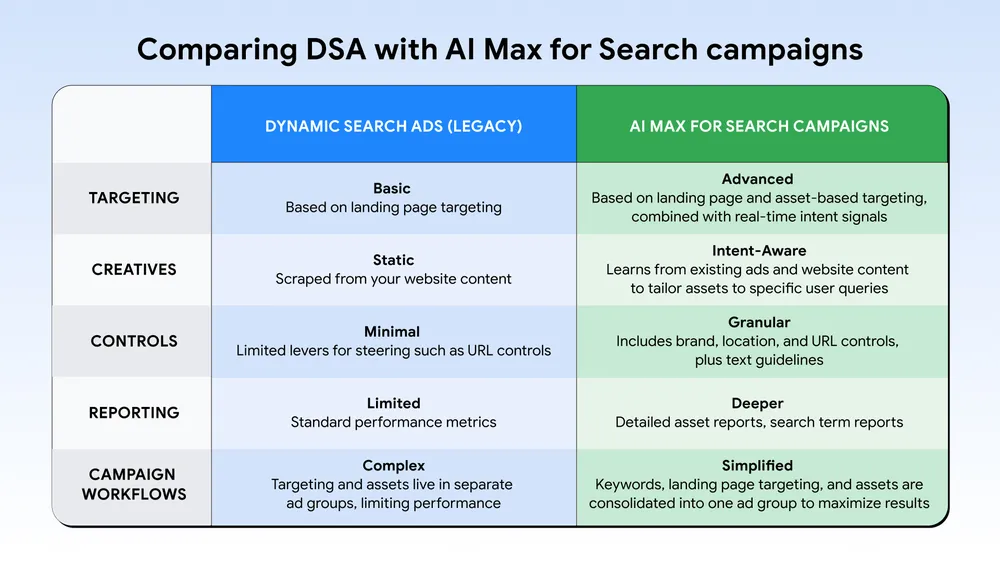
AI Max is Google’s AI-powered upgrade to Search campaign automation. DSA relied mainly on your website’s landing page content to generate headlines and match search queries. AI Max goes further: it combines your ads, website content, and real-time intent signals to find relevant queries you would otherwise miss.
Google’s reasoning is straightforward. Consumer searches have become more complex and harder to predict. A single product or service can be searched in dozens of different ways, and no keyword list or page crawl can cover all of them. AI Max is built to handle this.
According to Google’s official announcement, AI Max delivers an average of 7% more conversions or conversion value at a similar CPA/ROAS (for non-retail advertisers) when using the full feature suite, including search term matching, text customization, and final URL expansion, compared to using search term matching alone.
What is actually changing
Three legacy features are being phased out:
Dynamic Search Ads (DSA): dynamically generated headlines and landing pages based on site content
Automatically Created Assets (ACA): auto-generated ad copy elements
Campaign-level Broad Match setting: broad match applied at campaign level rather than keyword level
From September 2026, you will no longer be able to create new campaigns using these features in Google Ads, Google Ads Editor, or the Google Ads API. All existing eligible campaigns will be automatically migrated to AI Max.
AI Max is not just DSA with a new name. It has three main features.
Search Term Matching uses real-time intent signals to match your ads to relevant queries beyond your keyword lists and landing pages.
Text Customization adapts your ad copy dynamically to fit the search query and context, instead of using static or page-scraped headlines.
Final URL Expansion sends users to the most relevant page on your site for a given query, not only the URL you have set manually.
AI Max also gives you more control than DSA ever did: brand controls, location controls, and text guidelines that let you guide the AI with precision.
The migration timeline
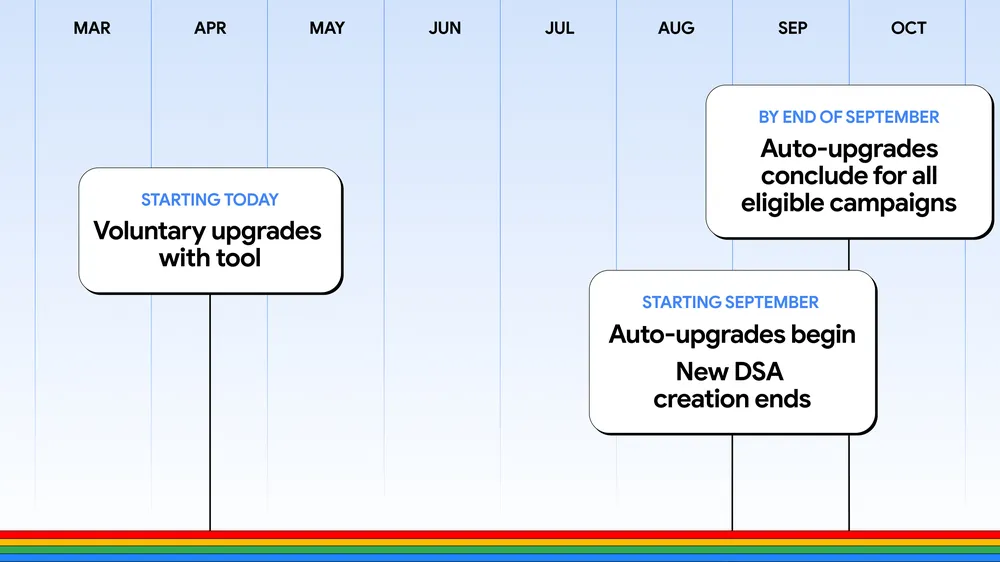
Now through August: Voluntary upgrades
Google strongly recommends migrating before the automatic upgrades begin. Upgrade tools are already being rolled out:
DSA users will get tools to move campaign history, settings, and data into standard ad groups.
ACA and broad match setting users will see an in-platform prompt to switch to AI Max.
Migrating voluntarily means you stay in full control of your campaign setup from the start, instead of having Google’s default settings applied for you.
September 2026: Automatic upgrades begin
Campaigns that have not been migrated manually will be upgraded automatically, with settings configured to match your existing setup as closely as possible:
Dynamic Search Ads — Dynamic ad groups will be converted to standard ad groups. All three AI Max features will be activated and your original URL settings will be preserved.
Automatically Created Assets — AI Max will be enabled with search term matching and text customization turned on by default.
Campaign-level Broad Match — AI Max will be enabled with search term matching turned on by default.
Google expects all migrations to be completed by the end of September 2026.
What About Keywords?
A common concern is whether this change makes keyword strategy less important. According to Google, it does not. A Google spokesperson confirmed that keywords remain “essential” and act as the “fuel” for the AI and its intent signals. The goal is to help advertisers manage campaigns more simply and reach beyond keywords, while staying in control, not to replace keyword targeting.
That said, the trend is clear. Google is steadily moving advertisers toward AI-driven automation, where manual controls become guardrails rather than the main way to manage campaigns.
What you should do now
Do not wait for September. Migrating early gives you control over your setup. Automatic upgrades will apply Google’s defaults, which may not match your business goals.
Test with one-click experiments first. Google’s built-in experiment feature lets you compare AI Max against your current DSA setup before fully committing.
Enable all three AI Max features. Google’s data shows the 7% conversion uplift comes from using the full feature set together. Using only search term matching without text customization or URL expansion reduces the potential gains.
Configure brand and location controls. AI Max lets you restrict which brands and locations the AI targets. Set these up before migration to avoid reaching audiences you do not want.
Review your landing pages. AI Max’s URL expansion will send users to the page it considers most relevant. A clean, well-organized site structure helps the AI make better decisions.
Check the Help Center. Google has published a full guide on feature mapping and eligibility at the Google Ads Help Center.
This is how to upgrade your DSA campaign to AI Max
The bigger picture
This is part of a pattern that has been building for years. Google has steadily retired manual and rule-based tools, including Enhanced CPC, similar audiences, and campaign-level broad match settings, and replaced them with AI-driven alternatives like Smart Bidding, Performance Max, and now AI Max. The direction is consistent: let the AI optimize, give it the right signals, and focus on measuring outcomes.
For advertisers with deep experience in DSA, there will be a learning curve. But the performance data points in AI Max’s favor, as long as you set it up carefully rather than leaving it on default settings.
The deadline to migrate on your own terms is September. Starting now is the smarter choice.
Coming soon:
Product analytics
Now you can track, compare, and optimize product performance across all your campaigns in one place. Try it out!