AI Max for Search: What it is any why marketers are talking about it
In 2025, Google rolled out a major upgrade to its Search advertising platform called AI Max for Search. This is a suite of AI-driven enhancements designed to charge classic Search campaigns inside Google Ads.
Marek Turnhofer
January 13, 2026
Show table of contents
Rather than replacing Search, AI Max adds advanced automation to existing campaigns, helping advertisers improve performance, relevance, and efficiency. Or so Google claims. As advertisers, we are now able to opt-in to AI Max features that allow Google’s AI to better match user intent, generate more effective creative, and even select the best landing pages.
What exactly is AI Max for Search?
At its core, AI Max for Search is a collection of optional AI-powered features you can enable within your existing Google Search campaigns. These features aim to help advertisers:
Improve search term matching beyond manually chosen keywords
Customize ad text dynamically to align with user queries
Expand landing URLs to increase relevance and conversions
Key features of AI Max for Search
1/ Search Term Matching (Including Keywordless Matching)
A cornerstone of AI Max is its search term matching, a combination of broad match and keywordless signals. This means Google’s AI uses contextual clues from your:
Keywords
Landing pages
Creative assets
to determine when and where your ads should show, even if you haven’t manually added specific keywords. This expands coverage into relevant queries you might otherwise miss while keeping a focus on intent.
2/ Asset & text customization
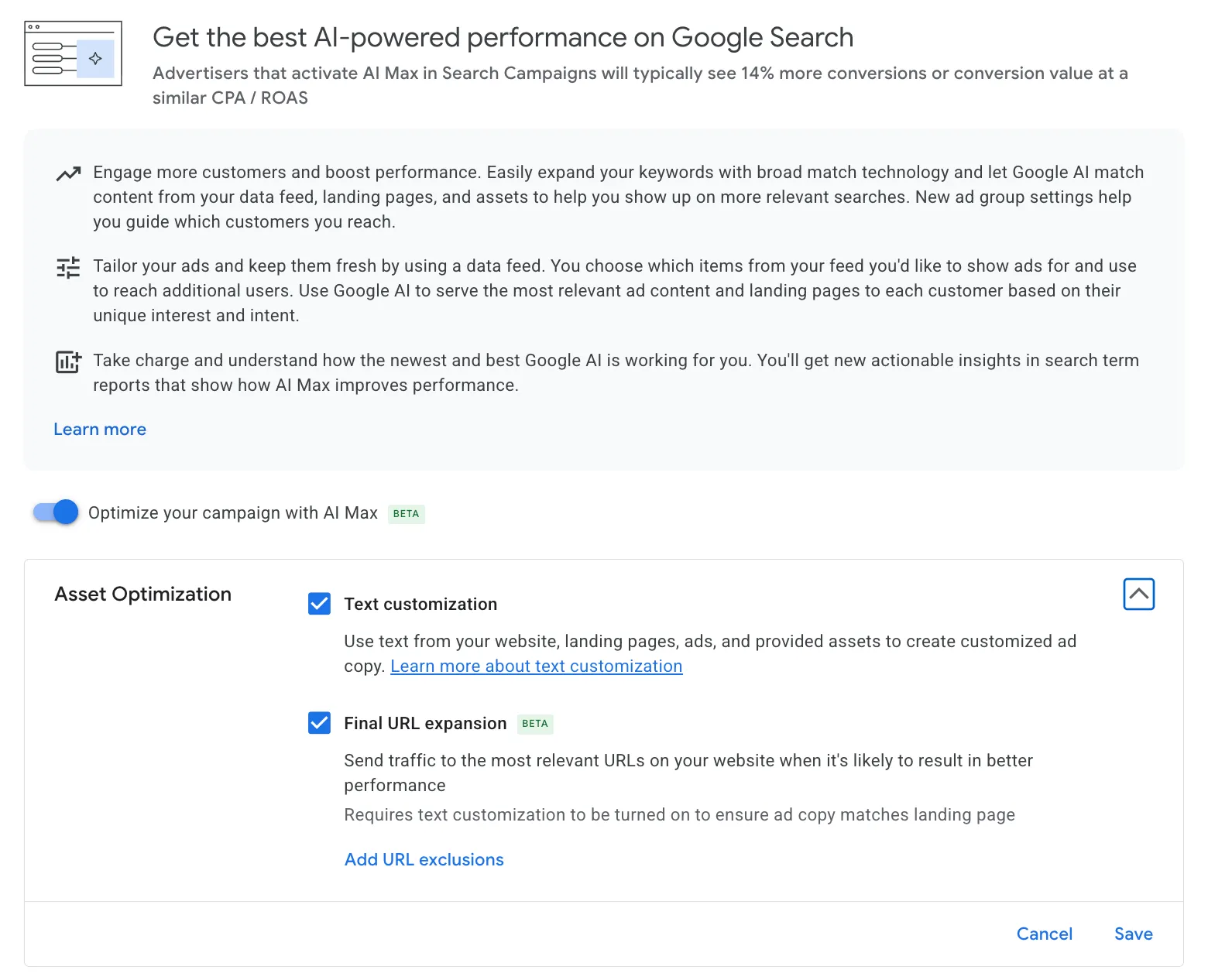
AI Max can dynamically generate or tailor ad headlines and descriptions using AI. It analyzes your existing assets, landing page content, and conversion goals to craft ad text that better resonates with users.
Google has improved this capability over earlier “automatically created assets,” and it now focuses on clearer calls-to-action and stronger consumer messaging.
3/ Final URL Expansion
With final URL expansion, AI Max can route traffic not just to your original landing page, but to the most relevant page on your site for a given query. This works similarly to Dynamic Search Ads (DSA) but with more intelligent, AI-driven decisions about where users should land.
This only works when paired with text customization, meaning both creative and landing pages adapt in sync.
How it fits into campaign setup
AI Max appears as a toggle within the standard Google Search campaign setup flow. Enable it when creating a campaign or apply it to existing ones — and can also test its impact using experiments that split traffic between AI Max and traditional settings.
Once enabled, Google adds new reporting views that show:
Search terms sourced by AI Max
How creative assets are performing
Landing page performance relative to AI decisions
This represents an improvement in transparency compared with earlier automated formats like Performance Max, which historically lacked clear insights.
What marketers think
Positive early feedback
Reach and conversions: Brands with AI Max enabled have reported positive uplift in conversion rates and new traffic beyond traditional keyword targeting, often with similar cost per action.
Greater efficiency: By automating creative testing and keyword discovery, AI Max can save time and reduce manual campaign management.
AI + AI marketing: Some marketers describe AI Max as an opportunity to meet AI with AI as it allows algorithmic optimization on both ad targeting and message delivery.
Watching closely
Control vs automation: Some marketers worry that letting Google’s AI pick keywords or landing pages could reduce control over strategy or budget allocation.
Relevance vs reach balance: Increased traffic does not always mean quality traffic, early tests show some long-tail queries driving clicks with minimal conversion value.
Reporting complexity: Though reporting has improved, understanding exactly how AI Max makes decisions and attributing results still requires careful analysis.
How to start with AI Max
For marketers looking to take advantage of AI Max, experts recommend approaching it strategically:
Test before going full mode: Run A/B experiments where possible to see how AI Max impacts your key metrics.
Start with controlled campaigns: Apply AI Max to select campaigns or budgets before broad adoption.
Monitor performance and relevance: Pay attention not just to volume, but to quality of conversions and ROI.
Conclusion
AI Max for Search reflects a broader shift toward intent-driven advertising. By combining automation with traditional Search campaign structures, it allows advertisers to reach users more effectively in a search environment that is increasingly complex and conversational.
For marketers willing to test and adapt, AI Max offers a powerful way to improve Search performance while keeping strategy and goals firmly in human hands.
Free webinar
Peak season is coming. Don’t screw it up
Get ready for the biggest shopping days of the year. October 20, 10:00 AM (UTC+2).