Beauty e-commerce growth looks healthy on the surface. Traffic rises. New channels emerge. Social commerce expands. But profitability tells a different story. This articles s based on conclusion based on global industry researches.
Marek Turnhofer
March 24, 2026
Show table of contents
The traditional funnel is breaking. Discovery happens in video. Consideration stretches across platforms. Returns eat margin. Inventory write-offs silently erode profit. Customer acquisition costs rise. Growth without discipline leaks cash.
The brands that win in 2026 and beyond operate with a new playbook: beauty ecommerce unit economics first, scale second.
Disclaimer: This article combines insights from industry research and public financial disclosures from sources like BCG, McKinsey, NIQ, Oberlo (global e-commerce growth outlook), THG), and Ulta Beauty (loyalty member scale and revenue contribution).
This article breaks down what that means and how to operationalize it.
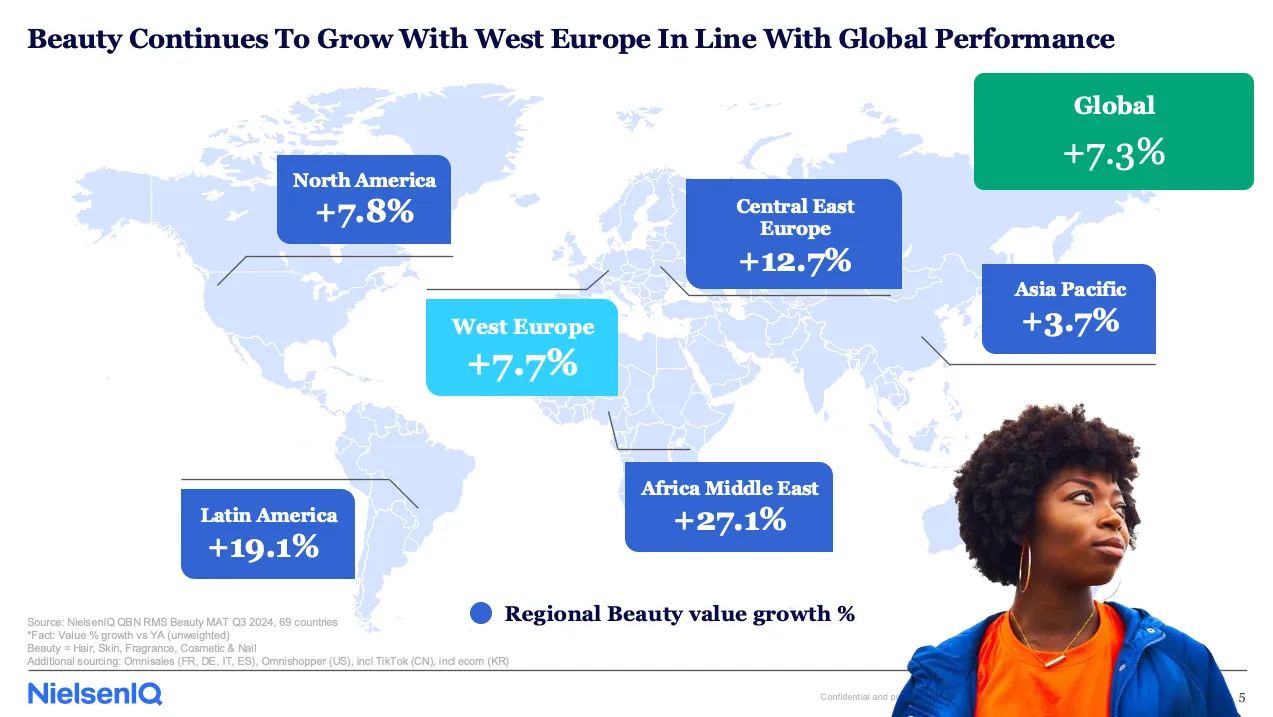
The good news is that Beaty continues to grow (source: NielsenIQ)
Why the funnel is breaking
Beauty used to follow a simpler path:
Awareness → Consideration → Purchase → Repeat.
Today, the journey is fragmented and nonlinear:
Consumers spend ~4 hours per week researching and discovering products.
Video influences decisions earlier than performance channels detect.
Social commerce compresses discovery and checkout into one scroll.
Returns and write-offs reverse revenue after it has already been booked.
Top-line growth hides three silent margin drains:
Returns (6% in health & beauty)
Cost per return: $29 (£27)
Inventory write-downs (e.g., £38.5m reported by THG in 2024)
At the same time, loyalty economics show that repeat purchase — not acquisition — drives structural advantage. Ulta generates >95% of sales from 44.6m loyalty members.
Growth is no longer about pushing more traffic.
It is about designing systems that:
Reduce returns.
Prevent inventory aging.
Increase cohort LTV.
Measure influence beyond last click.
Coordinate content with operations.
Let’s break this down.
Video is a conversion lever and your attribution model may hide it
Video in beauty is not just awareness. It drives measurable decisions.
Data shows:
34% of respondents say video prompted the purchase of a specific item.
45% say it helped choose a product or brand.
YouTube is 1.6× more likely to influence purchase decisions than social platforms in the same study.
If video influences product selection upstream but doesn’t receive the last click, budgets shift away from it, despite its causal impact. This creates a measurement trap: You cut the very channel that reduces uncertainty and drives higher-intent sessions.
Yet many brands still allocate budgets based on last-click ROAS. That creates a structural distortion. Influence happens upstream, while investment decisions are made downstream.
Video reduces uncertainty before checkout. It answers the questions that drive hesitation in beauty:
Is this the right shade?
Will this texture suit my skin?
Does it actually work in real life?
When uncertainty drops, three outcomes shift:
Conversion rate improves.
Average order value increases.
Return probability declines.
The state of beauty today is not a lack of performance channels. It is a measurement gap. Brands that fail to capture incremental influence risk underfunding the very formats shaping purchase decisions.
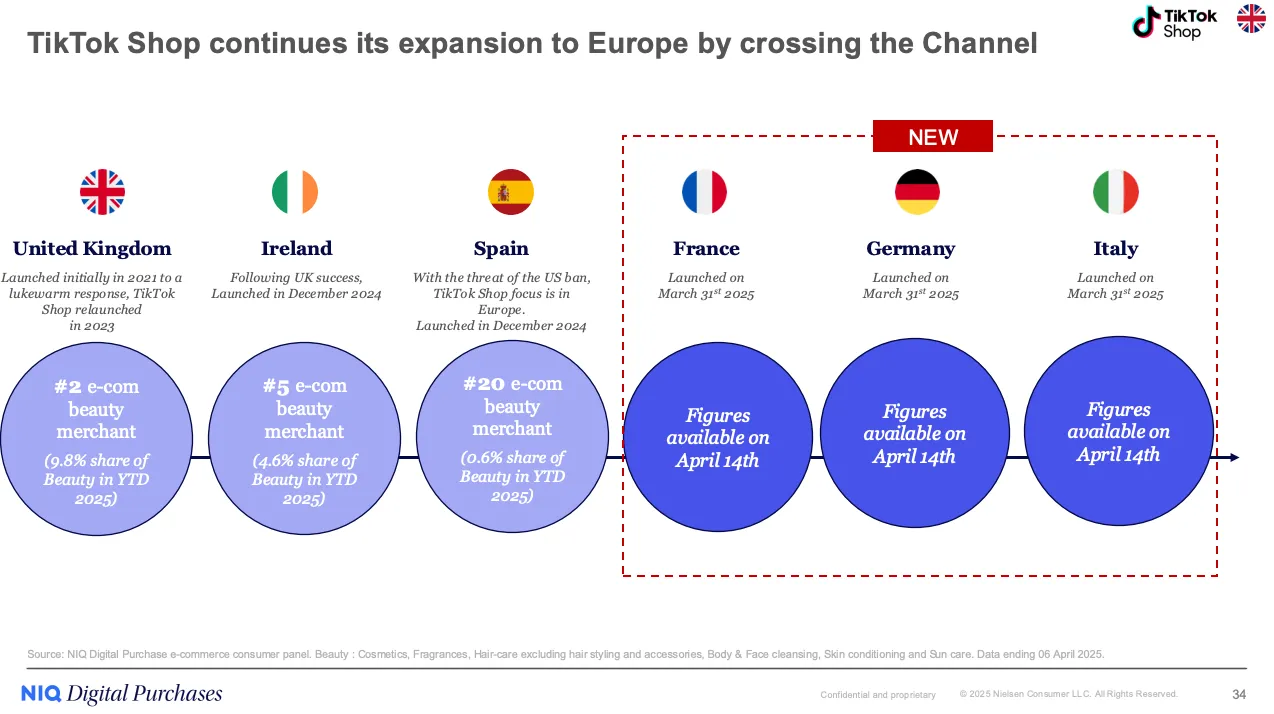
TikTok is becoming the strongest video reach platform in Europe (source: NielsenIQ)
If you allocate a budget based on different and more complex attribution models, you are the winner here!
Returns: A structural margin drag
The health and beauty return rate averages around 6%. Each return costs approximately $29 (£27).
That figure compounds across reverse logistics, customer service, payment fees, and in some cases lost inventory value. Returns are not neutral transactions. They directly impact contribution margin.
Most beauty returns stem from expectation gaps rather than defects. The primary drivers remain consistent:
Shade mismatch
Texture or performance disappointment
Damage in transit
Delivery delays
Impulse-driven buyer remorse
Each reflects a breakdown in alignment between promise and experience.
As acquisition costs rise, the economic tolerance for preventable returns shrinks. A one-percentage-point reduction in return rate can materially improve margin at scale. For a £10m business, moving from 6% to 4.5% returns can recover £150,000–£200,000 in profit before growth.
The state of beauty commerce is shifting: return management is no longer operational housekeeping. It is central to beauty ecommerce unit economics.
Inventory write-downs
Returns are visible. Inventory write-downs are slower and often larger.
THG reported:
£38.5m in inventory write-downs (2024)
Up from £20.4m (2023)
£1.3m recorded as a “right to recover asset”
Beauty assortments amplify inventory risk due to:
Fast-moving trend cycles
Expanding shade portfolios
Influencer-driven demand spikes
Limited shelf life
When sell-through decelerates but purchasing decisions assume peak velocity, markdowns follow. When markdowns fail, accounting adjustments absorb the difference.
Revenue can grow while profitability quietly declines.
The state of beauty growth today demands tighter synchronization between marketing velocity and inventory discipline. Campaign acceleration without aging control converts demand generation into margin compression.
Social Commerce compresses the system
NIQ reports TikTok Shop holds 9.8% share in the UK.
That is meaningful distribution and meaningful operational pressure. Social commerce compresses the entire cycle:
Discovery → Purchase → Delivery → Review → Return
Into days.
Without coordination between content teams, merchandising, supply chain, and customer support, volatility increases. Viral demand without depth planning results in stockouts. Refund rates spike. Customer trust erodes.
Loyalty is becoming the structural advantage
Ulta reports:
44.6m active loyalty members
More than 95% of sales from members
A target of 50m members by 2028
This level of penetration shifts economics fundamentally.
High loyalty density:
Reduces effective CAC
Increases repeat purchase frequency
Stabilizes demand forecasting
Improves inventory planning accuracy
In an environment where global e-commerce growth is expected to decelerate toward 2028–2029, loyalty becomes more than a retention channel. It becomes the foundation of predictable revenue.
The state of beauty e-commerce today shows a widening gap between brands dependent on continuous acquisition and those building repeat-driven ecosystems.
Top-line growth remains visible. But profitable growth now depends on how well brands manage:
Return friction
Aging inventory
Attribution gaps
Loyalty penetration
But growth is becoming less forgiving. Margin leaks that once hid behind rapid expansion are now fully exposed. The brands that win will align discovery, operations, and retention around one principle: profitable scale.
Discovery must reduce returns. Content must match inventory depth. Acquisition must feed loyalty. Velocity must respect aging risk.
Unit economics is the competitive battlefield now.
Free webinar
Peak season is coming. Don’t screw it up
Get ready for the biggest shopping days of the year. October 20, 10:00 AM (UTC+2).