Universal Commerce Protocol (UCP): This will change how people buy stuff online
In January 2026, Google launched something called Universal Commerce Protocol (UCP). If you work in marketing, SEO, or e-commerce, you might have heard it described as: “That new AI checkout thing in Google.” Understandable, but wrong.
Marek Turnhofer
March 24, 2026
Show table of contents
UCP is not a feature, not a plugin, and not a Google-only experiment.It is a new technical standard that could change how people buy products online, especially when AI assistants become the main way people search and decide.
Think of UCP less like Google Shopping and more like HTTP for shopping. You don’t see HTTP when you browse the web but nothing works without it. UCP aims to play the same role for AI-driven commerce.
What changes: From clicking websites to talking to AI
Let’s start with what actually changes for users.
Old model (this is how it works today)
User searches on Google
Clicks multiple websites
Compares products in tabs
Adds to cart
Goes through checkout
Often abandons the cart
New model (already live in the US)
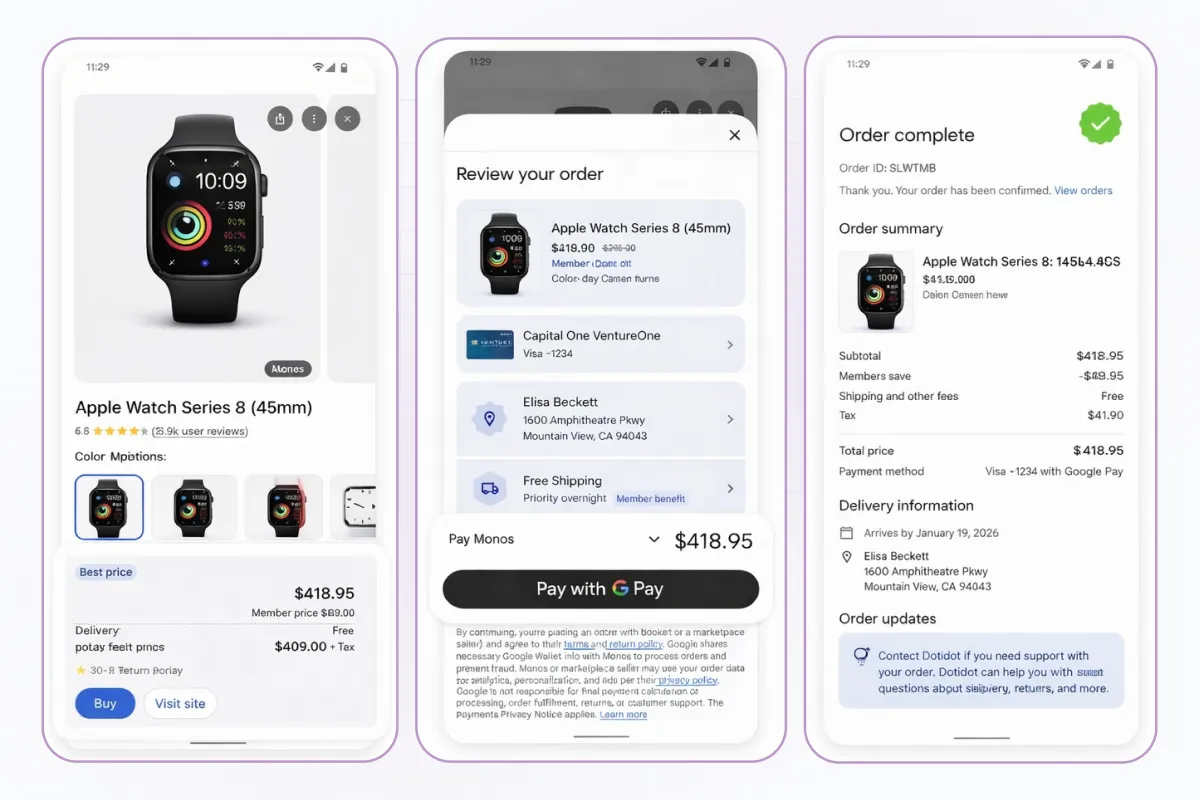
User says: “I need a lightweight running sneakers under $200 for a the trip across India.”
AI understands intent
AI finds suitable products
AI shows the best options
User says: “Buy this one.”
Done, without leaving the conversation
No tabs.
No forms.
No classic “checkout page”.
That experience is powered by UCP.
This is not just a Google thing
It would be easy to ignore this if it were “just Google testing something”.
But UCP was co-developed with major players:
Shopify
Walmart
Target
Etsy
Wayfair
And supported by payment networks like:
Visa
Mastercard
Stripe
PayPal
That matters, because it signals something important:
The entire industry agrees that AI agents need a shared way to talk to e-shops.
Without that, AI commerce simply does not scale.
What is UCP trying to solve
Let’s strip away all technical language and look at the problem in simple terms.
Imagine a future with multiple AI assistants that can shop for users:
Google AI
ChatGPT
Claude
Perplexity
Others that do not exist yet
Without a standard, every one of these agents would need a custom integration with every e-shop. And every e-shop would need to support all of them separately. That quickly becomes impossible to maintain.
UCP solves this by creating one shared language. An e-shop describes what it can do in a standardized way. Any AI agent that understands UCP can read that description and interact with the shop correctly.
In practice, this means: integrate once, become available everywhere.
What UCP is (without the technical jargon)
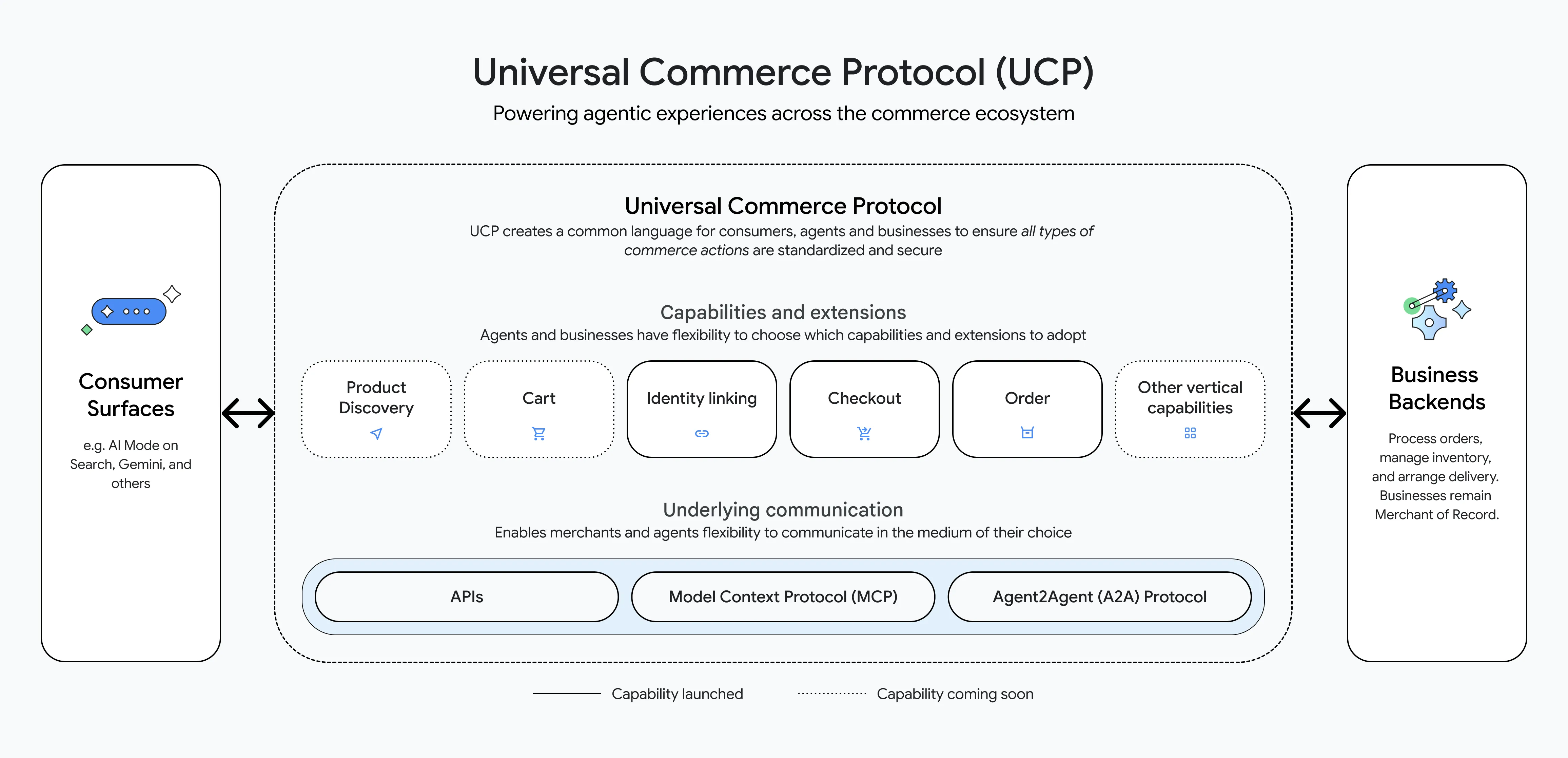
At its core, Universal Commerce Protocol is a rulebook. It defines how an e-shop can say things like:
The e-shop publishes this information in a machine-readable way. The AI reads it, checks what is compatible, and decides whether it can safely complete a purchase.
Instead of guessing, scraping websites, or relying on fragile workarounds, everything is explicit and predictable.
And here some technical jargon infographics :)
It matters even if you are not in the US
At this point, many marketers outside the US will think: “Interesting, but not relevant for us yet.” You might be one of them. That reaction is understandable, but risky.
Even if UCP itself arrives in your market (in 2027 or… never) the logic behind it is already shaping how AI systems evaluate businesses.
AI agents increasingly decide:
which products are relevant
which merchants are trustworthy
which options are safe to recommend
And they make those decisions based on structured data, not on beautifully designed landing pages.
Another uncomfortable truth: AI agents do not read websites the way humans do.
They do not scroll.
They do not admire layouts.
They consume structured data.
For Google-based AI commerce, that data lives primarily in Merchant Center:
product feeds
availability
pricing
shipping rules
return policies
trust and compliance information
This means that, for AI-driven shopping, Merchant Center can become more important than the website itself. Your website still matters for branding, trust, and fallback scenarios. But the decision logic increasingly happens elsewhere.
“But who owns the customer?”
UCP is explicitly designed so that the merchant remains the Merchant of Record. You are not selling through a marketplace in the traditional sense.
You:
own the transaction
receive customer data
handle delivery and returns
can remarket and build loyalty
control pricing and business logic
Google or any other AI agent is infrastructure, not an intermediary that takes over the relationship.
The future or just another experiment?
The honest answer is: we don’t know yet.
UCP is live. It has real implementations, real code, and real partners. But history shows that being live does not guarantee success.
What is certain is the direction. AI will increasingly mediate decisions between users and businesses. One of the first examples we’ve introduced was ChatGPT Shopping. Structured data, trust, and operational reliability will matter more than ever.
Even if UCP itself fails, the preparation for it is not wasted.
Coming soon:
Product analytics
Now you can track, compare, and optimize product performance across all your campaigns in one place. Try it out!