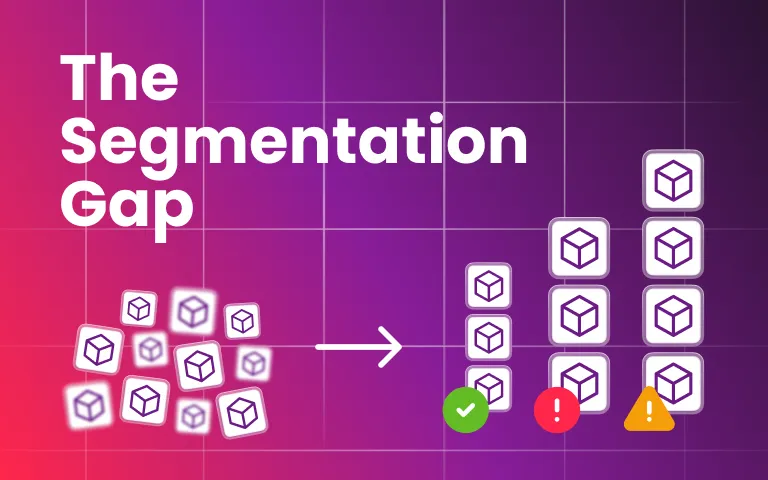
The segmentation gap: Why most e-commerce brands can't act on product performance
And how Product Analytics finally solves it. For years, marketers have trusted automation to make sense of complexity. Yet behind every “smart” campaign lies a structural data problem—one that hides inefficiency, distorts performance, and buries real growth potential.
Martina Pribylova
January 13, 2026
Show table of contents
The problem everyone knows but few can act on
AI-powered automated campaigns—Performance Max, Advantage+ —promise simplicity. Upload your products, set a target ROAS, and let AI do the heavy lifting.
But here's what actually usually happens: Your growth in performance after testing period looks great, until you dig one layer deeper and you'll find your top 20% of products are generating 8x ROAS while subsidizing the bottom 50% that barely break even. The algorithm doesn't care about your profit margins. It cares about conversions. Any conversions.
Meanwhile, your new product launches get buried under bestsellers from 2022. Seasonal inventory sits untouched while out-of-season items burn the budget. High-margin winners fight for impressions against low-margin losers.
This isn't a Google problem. It's a data problem.
And it's costing you 30-40% in potential efficiency gains—according to recent industry analysis of brands that moved from blended to segmented campaign structures.
Why segmentation isn't optional anymore
Let's talk about what segmentation actually means in 2025.
It's not just splitting campaigns by brand or category, which is still a valid strategy for some campaign types or industries. Real segmentation means organising your product catalog based on strategic performance metrics—ROAS, profit margin, inventory levels, seasonality, price competitiveness—and then building campaign structures that align budget allocation with business priorities.
Here's what advanced segmentation looks like in practice:
The framework that's become industry standard:
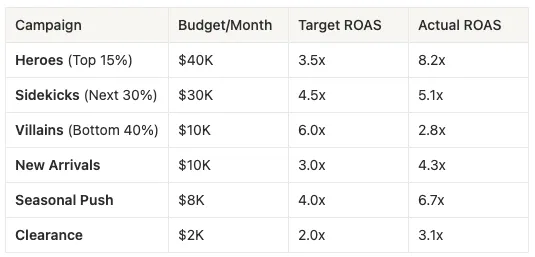
Heroes: Your top performers (8-12x ROAS). Aggressive budgets, lower ROAS targets to maximize volume.
Sidekicks: Products near target (4-6x ROAS). Moderate budgets, balanced approach.
Zombies: Products with zero or minimal impressions. Dedicated discovery budget or exclusion.
Brands using this framework typically see 30-40% efficiency improvements compared to simpler campaigns structures. Why? Because you're finally telling the algorithm what matters—not just letting it figure it out auction by auction.
But here's the catch
Most brands know they should segment. The problem is getting the data to do it effectively.
You need:
Product-level performance data from Google Ads and Meta (not just campaign-level)
Profit margins for each SKU (revenue alone lies)
Inventory levels (don't promote what you can't fulfill)
Historical trends (what sold last month might not sell this month)
Price competitiveness (are you even competitive on this product?)
Lifecycle stage (new products need different treatment than bestsellers)
Oh, and you need all this in one place, updated in real-time, and connected to your campaigns
This is where most brands hit a wall.
What advanced segmentation actually requires
Let's look at what fast-fashion retailer did to transform their marketing efficiency:
They implemented segment-specific ROAS targets based on:
Product category margins (higher targets for high-margin categories)
Customer acquisition vs. retention (lower targets for new customer acquisition)
Market maturity (lower ROAS expectations in emerging markets)
The result? They moved beyond their blended 4.2x ROAS and discovered massive optimization opportunities they couldn't see before.
But here's what they needed to make it work:
1. Multi-dimensional scoring
Not just "this product has 5x ROAS." But:
Base score ranking products by past performance
Predictive algorithms for products with little data
Boost mechanisms for new arrivals
Custom weighting based on business priorities
This is what industry leaders call "multi-dimensional segmentation"—and it's the difference between reactive campaign management and strategic growth.
2. Real-time data integration
Product performance isn't static. What was a hero last month might be a villain this month because:
Competitors dropped their prices
You ran out of stock
Seasonal demand shifted
Margin pressure changed
You need continuous data refresh across all these dimensions. Not monthly exports. Not weekly updates. Real-time.
3. Automated campaign sync
Once you've identified your product buckets, you need to:
Update campaign product sets
Exclude shifted products from old campaigns
Adjust budget allocations
Modify ROAS targets
Monitor for issues
Manually, this is a full-time job. Automated, it happens while you sleep.
Start small, scale on strong foundations
Understanding your product portfolio isn't a nice-to-have for performance teams—it's a competitive requirement. After analyzing hundreds of campaign structures and product data across countries and industries, we found that 80% of accounts have potential savings of up to 20% while maintaining the same revenue.
The best part? You don't need huge structural changes to your running campaigns. No risk of losing precious campaign historical data.
You don't need to collect every possible data source from day one. You just need to shift your view from campaign-level optimization to product-level optimization.
One look from a different angle than your performance team usually takes—and boom, you might have just found thousands of dollars to reallocate. Simple, fast, and with immediate impact.
Enter: Product Analytics
This is what we built Product Analytics to solve.
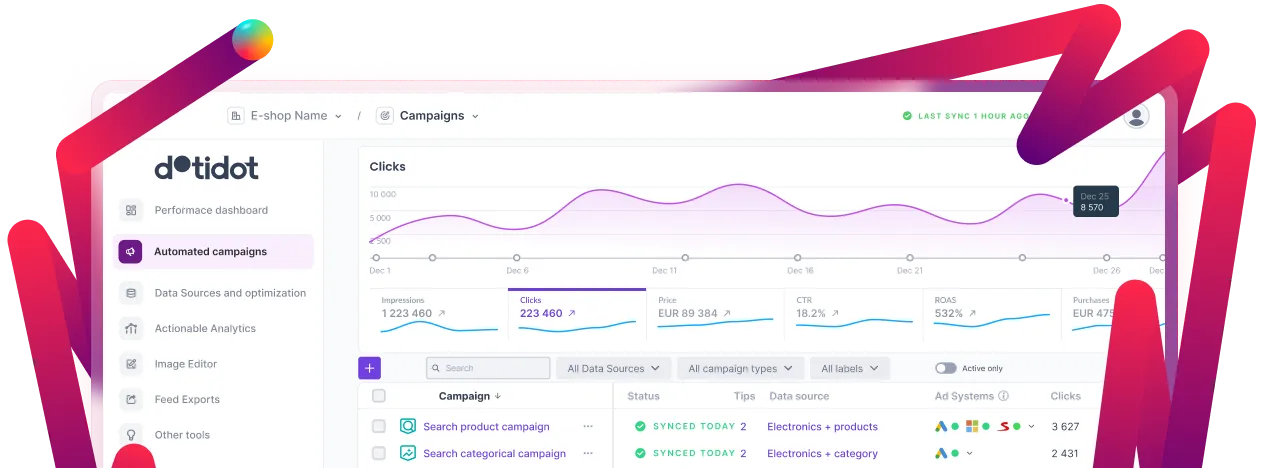
Not as a reporting dashboard. Not as a nice-to-have add-on. But as the foundational layer that makes advanced segmentation actually possible and easy to implement.
Google Ads performance (clicks, conversions, spend, ROAS)
Meta Ads performance (same metrics, different channel)
Your product feed (SKUs, prices)
All in one place. Automatically synced. Product-level granularity.
2. Issues under spotlight
Within minutes Product Analytics shows you a specific issues:
Where your budget really goes
Which products waste money
Which items deserve more visibility
Your portfolio balance and budget concentration
Remember the Heroes/Sidekicks/Villains/Zombies framework? Villains are the products you need to uncover and fix. Product Analytics highlights them as Underperformers or Losers and alerts you to how serious the problem is.
3. Choosing the right product strategy and segmentation
Once you know which products are wasting or even burning your budget, and which are inactive or not being promoted, it’s time to choose the right Product Strategy.
If you use the Heroes/Sidekicks/Villains/Zombies framework, consider these two popular approaches:
ROAS strategy – split products by their actual performance within the ad system
POAS strategy – split products by how profitable they are when advertised
By choosing either of these strategies, you divide products into Heroes, Sidekicks, and Villains.
Time spent on segmentation: ~2 hours/month (down from 15-20)
Why this matters more than ever
Here's what's happening in e-commerce advertising right now:
CPCs are rising. Competition is intensifying. Customer acquisition costs are at all-time highs. The brands winning aren't spending more. They're spending smarter.
And "spending smarter" means:
Knowing which products actually make you money
Allocating budget based on profit, not just revenue
Giving new products a fighting chance
Not burning cash on products that don't convert
Adapting in real-time as performance shifts
All of this requires product-level intelligence that most platforms simply don't provide.
That's what Product Analytics was built for.
Coming soon:
Product analytics
Now you can track, compare, and optimize product performance across all your campaigns in one place. Try it out!