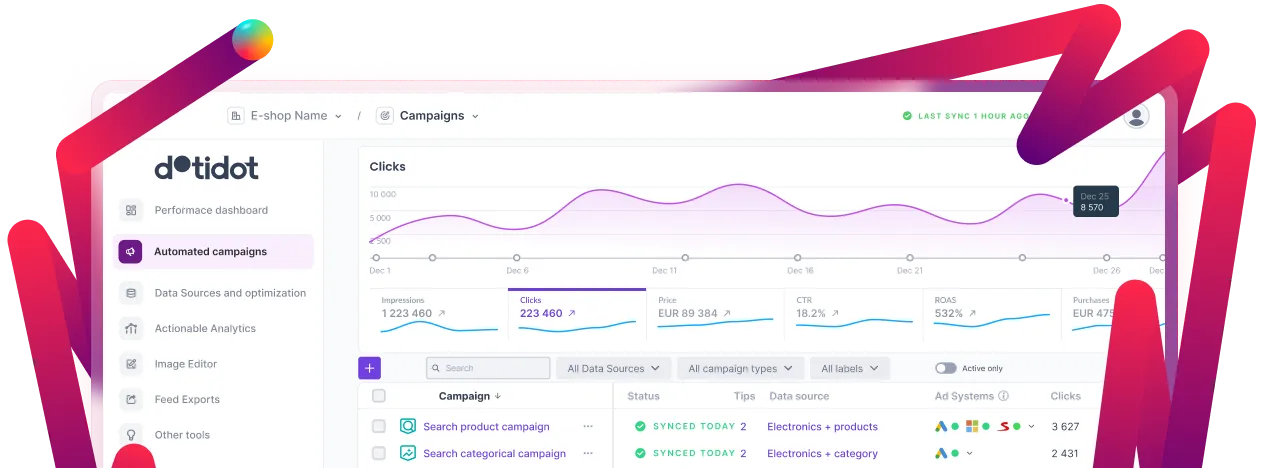
Driving more traffic to your store won't guarantee revenue growth if your products, pricing, and campaigns aren't optimized for conversion. This article explores how shifting focus from traffic volume to product-level insights can unlock sustainable, scalable growth and how tools like Dotidot's Product Analytics help you identify what's actually driving profit.
Growth beyond traffic: The shift in e-commerce priorities
For years, marketers have obsessed over traffic metrics. More visitors, more impressions, more clicks. But here's the uncomfortable truth: traffic alone doesn't pay the bills. Revenue does. And the gap between these two is often wider than most businesses realize.
The real opportunity lies not in driving more people to your store, but in understanding what happens once they arrive. Which products convert? Which ones drain your budget without returning value? Where are the hidden profit margins you're leaving on the table?
Sustainable growth comes from answering these questions with data, not assumptions.
Improving conversion rates at the product pevel
Your overall conversion rate is a vanity metric. What matters is the conversion rate of individual products and how they contribute to your bottom line.
- Start by identifying which products have high traffic but low conversion. These are your optimization opportunities.
- Products with strong conversion rates but low traffic need more visibility in your campaigns.
- Products with both low traffic and low conversion should be evaluated for removal or repositioning.
Use product segmentation to group items by performance tier, then allocate budget accordingly. This approach ensures your ad spend flows toward products that actually generate returns.
Tip: Review your product-level conversion data weekly. Small improvements across your top 20 products can often outperform massive traffic increases to your entire catalog.
Optimizing your product mix
Not all products deserve equal attention in your marketing strategy. Some products serve as traffic drivers, others as profit centers, and some simply fill catalog space without contributing meaningfully to revenue.
- Analyze your product catalog through the lens of revenue contribution, margin, and velocity.
- Identify your bestsellers and ensure they receive adequate campaign budget and visibility.
- Spot underperformers (or Zombie products) that consume impressions without generating clicks or conversions.
- Evaluate seasonal products and adjust their prominence based on demand patterns.
A well-optimized product mix ensures that your marketing efforts amplify winners rather than prop up losers.
Pricing and offer strategy
Pricing directly impacts both conversion rate and profitability. Yet many e-commerce businesses set prices once and forget about them, missing opportunities to respond to market dynamics.
Consider implementing dynamic pricing strategies that account for competitor pricing, demand fluctuations, and inventory levels.
Test different offer structures: free shipping thresholds, bundle discounts, or limited-time promotions. Track which offers drive incremental revenue versus simply shifting existing demand.
Pay attention to price elasticity at the product level. Some products can absorb price increases with minimal conversion impact, directly improving margins.
Improving traffic quality
If you must focus on traffic, focus on quality over quantity. A thousand visitors with no purchase intent cost money without delivering value.
- Refine your targeting to reach audiences with demonstrated buying signals.
- Use negative keywords to filter out irrelevant search queries that waste your ad budget.
- Segment your campaigns by audience intent—prospecting campaigns should have different goals and metrics than retargeting campaigns.
- Align your ad creative and landing pages with user expectations. Misaligned experiences drive up bounce rates and tank conversion.
Scaling winning products
Once you've identified your top performers, the goal shifts to scaling them efficiently. This requires a structured approach to budget allocation and campaign management.
- Increase bids and budgets incrementally on proven winners while monitoring for diminishing returns.
- Expand successful products to additional channels—if something works well in Google Shopping, test it in Meta Advantage+ or other platforms.
- Create dedicated campaigns for your bestsellers to give them more control over bidding and targeting.
- Use automation tools to maintain optimal performance as you scale, adjusting bids and budgets based on real-time data.
Tip: Before scaling any product, verify that your margins can sustain increased acquisition costs. Higher volume often means higher CPAs—make sure the math still works.
Eliminating revenue leaks
Revenue leaks occur when inefficiencies in your marketing or operations silently drain profit. Common culprits include:
- Products advertised while out of stock, wasting clicks and frustrating customers.
- High-cost products with low margins receiving disproportionate ad spend.
- Campaigns targeting locations or audiences with historically poor conversion rates.
- Feed errors that cause products to be rejected or displayed incorrectly in shopping ads.
Regularly audit your campaigns and product feeds to identify and plug these leaks before they compound.
How to achieve sustainable growth
Sustainable growth isn't about finding the next growth hack. It's about building systems that consistently identify opportunities and optimize toward profit.
- Establish clear performance metrics: Move beyond ROAS to metrics that reflect actual profitability. Consider POAS (Profit on Ad Spend) or contribution margin per product as your north star metrics.
- Implement continuous optimization loops: Set up regular review cycles where you analyze product performance, adjust segmentation, and reallocate budget. Monthly is the minimum; weekly is better for high-volume stores.
- Leverage Product-level insights: The key to sustainable growth lies in product-level visibility. Understanding exactly which products drive profit—and which destroy it—enables smarter decisions across pricing, inventory, and marketing.
This is where tools like Product Analytics from Dotidot become essential. The feature provides granular visibility into how each product performs across your campaigns, helping you identify winners to scale, underperformers to cut, and optimization opportunities you might otherwise miss.
With product-level insights, you can segment your catalog by actual revenue contribution, connect performance data to your campaigns, and make allocation decisions based on profit rather than guesswork.
Conclusion
Growing revenue beyond traffic requires a fundamental mindset shift. Instead of chasing more visitors, successful e-commerce businesses focus on extracting more value from every click, every product, and every campaign.
The path forward involves optimizing your product mix, eliminating waste, scaling what works, and building systems for continuous improvement. With the right product-level insights, you can move from reactive marketing to proactive revenue management—and that's where sustainable, scalable growth begins.